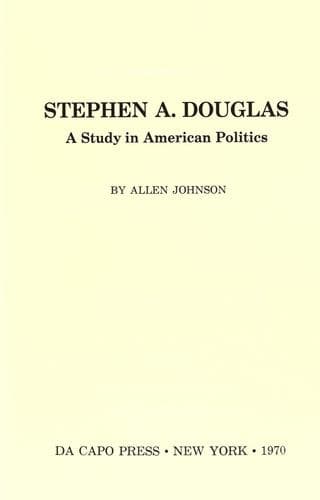
Stephen A. Douglas: A Study in American PoliticsJohnson, Allen
History
Stephen A. Douglas: A Study in American Politics
Johnson, Allen
Douglas, Stephen A. (Stephen Arnold), 1813-1861
By successful gerrymanders it had secured the
lion's share of congressional districts. Above all it had intelligent
leadership. The retirement of Senator Breese left Stephen A. Douglas
the undisputed leader of the party.
The dual party system in Illinois, as well as in the nation, was
seriously threatened by the appearance of a third political
organization with hostility to slavery as its cohesive force. The
Liberty party polled its first vote in Illinois in the campaign of
1840, when its candidate for the presidency received 160 votes.[314]
Four years later its total vote in Illinois was 3,469, a notable
increase.[315] The distribution of these votes, however, is more
noteworthy than their number, for in no county did the vote amount to
more than thirty per cent of the total poll of all parties. The
heaviest Liberty vote was in the northern counties. The votes cast in
the central and southern parts of the State were indicative, for the
most part, of a Quaker or New England element in the population.[316]
As yet the older parties had no reason to fear for their prestige; but
in 1848 the Liberty party gave place to the Free-Soil party, which
developed unexpected strength in the presidential vote. It rallied
anti-slavery elements by its cry of "Free Soil, Free Speech, Free
Labor, and Free Men!" and for the first time broke the serried ranks
of the older parties. Van Buren, the candidate of the Free-Soilers,
received a vote of 15,774, concentrated in the northeastern counties,
but reaching formidable proportions in the counties of the northwest
and west.[317] Of the older organizations, the Whig party seemed less
affected, Taylor having received 53,047 votes, an increase of 7,519
over the Whig vote of 1844. The Democratic candidate, Cass, received
only 56,300, an absolute decrease of 1,620. This was both an absolute
and a relative decline, for the total voting population had increased
by 24,459. Presumptive evidence points to a wholesale desertion of the
party by men of strong anti-slavery convictions. Whither they had
gone--whether into the ranks of Whigs or Free-Soilers,--concerned
Democratic leaders less than the palpable fact that they had gone
somewhere.
Public-domain text, read in full here on John Shaqi.
Reviews
Reviews
No reviews yet
Be the first to share your thoughts on this work.
Elsewhere in the archive
Join the Discussion
Join the discussion
Sign in to leave a comment or review.
Sign InorCreate an account