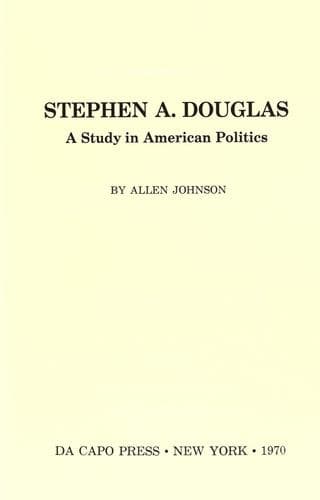
Stephen A. Douglas: A Study in American PoliticsJohnson, Allen
History
Stephen A. Douglas: A Study in American Politics
Johnson, Allen
Douglas, Stephen A. (Stephen Arnold), 1813-1861
Illinois with its North and its South was also facing a crisis. To the
social and political differences that bisected the State, was added a
keen commercial rivalry between the sections. While the State
legislature under northern control was appropriating funds for the
Illinois and Michigan canal, it exhibited far less liberality in
building railroads, which alone could be the arteries of traffic in
southern Illinois. At a time when railroads were extending their lines
westward from the Atlantic seaboard, and reaching out covetously for
the produce of the Mississippi Valley, Illinois held geographically a
commanding position. No roads could reach the great river, north of
the Ohio at least, without crossing her borders. The avenues of
approach were given into her keeping. To those who directed State
policy, it seemed possible to determine the commercial destinies of
the Commonwealth by controlling the farther course of the railroads
which now touched the eastern boundary. Well-directed effort, it was
thought, might utilize these railroads so as to build up great
commercial cities on the eastern shore of the Mississippi. State
policy required that none of these cross-roads should in any event
touch St. Louis, and thus make it, rather than the Illinois towns now
struggling toward commercial greatness, the entrepot between East and
West. With its unrivalled site at the mouth of the Missouri, Alton was
as likely a competitor for the East and West traffic, and for the
Mississippi commerce, as St. Louis. Alton, then, must be made the
terminus of the cross-roads.[327]
The people of southern Illinois thought otherwise. Against the
background of such distant hopes, they saw a concrete reality. St.
Louis was already the market for their produce. From every railroad
which should cross the State and terminate at St. Louis, they
anticipated tangible profits. They could not see why these very real
advantages should be sacrificed on the altar of northern interests.
After the opening of the northern canal, they resented this exclusive
policy with increased bitterness.
Upon one point, and only one, the people of northern and southern
Illinois were agreed: they believed that every possible encouragement
should be given to the construction of a great central railroad, which
should cross the State from north to south. Such a railroad had been
projected as early as 1836 by a private corporation. Subsequently the
State took up the project, only to abandon it again to a private
company, after the bubble of internal improvements had been pricked.
Of this latter corporation,--the Great Western Railroad
Company,--Senator Breese was a director and the accredited agent in
Congress. It was in behalf of this corporation that he had petitioned
Congress unsuccessfully for pre-emption rights on the public
domain.[328]
Public-domain text, read in full here on John Shaqi.
Reviews
Reviews
No reviews yet
Be the first to share your thoughts on this work.
Elsewhere in the archive
Join the Discussion
Join the discussion
Sign in to leave a comment or review.
Sign InorCreate an account