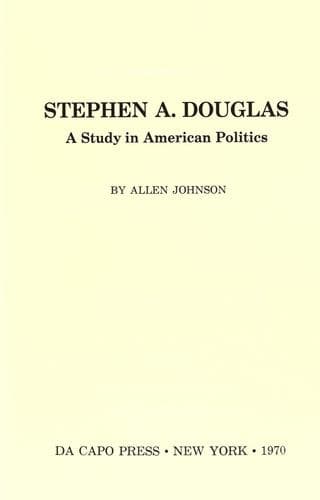
Stephen A. Douglas: A Study in American PoliticsJohnson, Allen
History
Stephen A. Douglas: A Study in American Politics
Johnson, Allen
Douglas, Stephen A. (Stephen Arnold), 1813-1861
Circumstances enlisted Douglas's interest powerfully in the proposed
central railroad. These circumstances were partly private and
personal; partly adventitious and partly of his own making. The
growing sectionalism in Illinois gave politicians serious concern. It
was becoming increasingly difficult to maintain the integrity of
political parties, when sectional issues were thrust into the
foreground of political discussion. Yankee and Southerner did not mix
readily in the caldron of State politics. But a central railroad which
both desired, might promote a mechanical mixture of social and
commercial elements. Might it not also, in the course of time, break
up provincial feeling, cause a transfusion of ideas, and in the end
produce an organic union?
In the summer of 1847, Senator-elect Douglas took up his residence in
Chicago, and identified himself with its commercial interests by
investing in real estate.[329] Few men have had a keener instinct for
speculation in land.[330] By a sort of sixth sense, he foresaw the
growth of the ugly but enterprising city on Lake Michigan. He saw that
commercially Chicago held a strategic position, commanding both the
lake traffic eastward, and the interior waterway gulfward by means of
the canal. As yet, however, these advantages were far from
realization. The city was not even included within the route of the
proposed central railroad. Influential business men, Eastern
capitalists, and shippers along the Great Lakes were not a little
exercised over this neglect. In some way the claims of Chicago must be
urged upon the promoters of the railroad. Just here Douglas could
give invaluable aid. He pointed out that if the railroad were to
secure a land grant, it would need Eastern votes in Congress. The old
Cairo-Galena line would seem like a sectional enterprise, likely to
draw trade down the Mississippi and away from the Atlantic seaports.
But if Chicago were connected with the system, as a terminal at the
north, the necessary congressional support might be secured.[331]
Public-domain text, read in full here on John Shaqi.
Reviews
Reviews
No reviews yet
Be the first to share your thoughts on this work.
Elsewhere in the archive
Join the Discussion
Join the discussion
Sign in to leave a comment or review.
Sign InorCreate an account