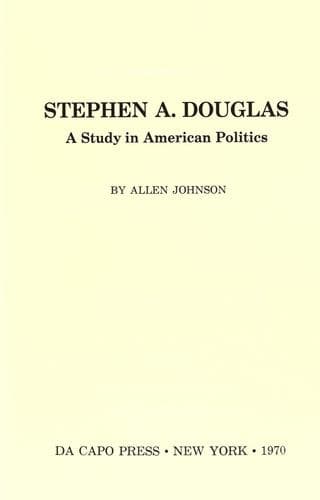
Stephen A. Douglas: A Study in American PoliticsJohnson, Allen
History
Stephen A. Douglas: A Study in American Politics
Johnson, Allen
Douglas, Stephen A. (Stephen Arnold), 1813-1861
During the summer, Douglas canvassed the State, speaking repeatedly in
behalf of this larger project. For a time he hoped that Senator Breese
would co-operate with him. Numerous conferences took place both before
and after Congress had assembled; but Douglas found his colleague
reluctant to abandon his pre-emption plan. Regardless of the memorials
which poured in upon him from northern Illinois, Breese introduced his
bill for pre-emption rights on the public domain, in behalf of the
Holbrook Company, as the Great Western Railway Company was popularly
called. Thereupon Douglas offered a bill for a donation of public
lands to aid the State of Illinois in the construction of a central
railroad from Cairo to Galena, with a branch from Centralia to
Chicago.[332] Though Breese did not actively oppose his colleague, his
lack of cordiality no doubt prejudiced Congress against a grant of any
description. From the outset, Douglas's bill encountered obstacles:
the opposition of those who doubted the constitutional power of
Congress to grant lands for internal improvements of this sort; the
opposition of landless States, which still viewed the public domain
as a national asset from which revenue should be derived; and,
finally, the opposition of the old States to the new. Nevertheless,
the bill passed the Senate by a good majority. In the House it
suffered defeat, owing to the undisguised opposition of the South and
of the landless States both East and West. The Middle States showed
distrust and uncertainty. It was perfectly clear that before such a
project could pass the House, Eastern and Southern representatives
would have to be won over.[333]
After Congress adjourned, Douglas journeyed to the State of
Mississippi, ostensibly on a business trip to his children's
plantation. In the course of his travels, he found himself in the city
of Mobile--an apparent digression; but by a somewhat remarkable
coincidence he met certain directors of the Mobile Railroad in the
city. Now this corporation was in straits. Funds had failed and the
construction of the road had been arrested. The directors were casting
about in search of relief. Douglas saw his opportunity. He offered the
distraught officials an alliance. He would include in his Illinois
Central bill a grant of land for their road; in return, they were to
make sure of the votes of their senators and representatives.[334]
Such, at least, is the story told by Douglas; and some such bargain
may well have been made. Subsequent events give the color of veracity
to the tale.
Public-domain text, read in full here on John Shaqi.
Reviews
Reviews
No reviews yet
Be the first to share your thoughts on this work.
Elsewhere in the archive
Join the Discussion
Join the discussion
Sign in to leave a comment or review.
Sign InorCreate an account