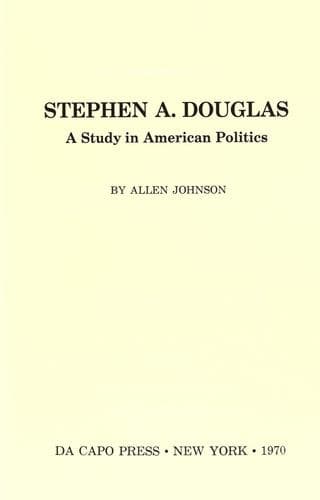
Stephen A. Douglas: A Study in American PoliticsJohnson, Allen
History
Stephen A. Douglas: A Study in American Politics
Johnson, Allen
Douglas, Stephen A. (Stephen Arnold), 1813-1861
Douglas was not chosen a member of the select Committee of Thirteen.
He could hardly expect to be; but he contributed not a little to its
labors, if a traditional story be true. In a chance conversation,
Clay, who was chairman of the committee, told Douglas that their
report would recommend the union of his two bills,--the California and
the Territorial bills,--instead of a bill of their own. Clay intimated
that the committee felt some delicacy about appropriating Douglas's
carefully drawn measures. With a courtesy quite equal to Clay's,
Douglas urged him to use the bills if it was deemed wise. For his
part, he did not believe that they could pass the Senate as a single
bill. In that event, he could then urge the original bills separately
upon the Senate. Then Clay, extending his hand, said, "You are the
most generous man living. I _will_ unite the bills and report them;
but justice shall nevertheless be done you as the real author of the
measures." A pretty story, and not altogether improbable. At all
events, the first part of "the Omnibus Bill," reported by the
Committee of Thirteen, consisted of Douglas's two bills joined
together by a wafer.[355]
There was one highly significant change in the territorial bills
inside the Omnibus. Douglas's measures had been silent on the slavery
question; these forbade the territorial legislatures to pass any
measure in respect to African slavery, restricting the powers of the
territorial legislatures at a vital point. Now on this question
Douglas's instructions bound him to an affirmative vote. He was in the
uncomfortable and hazardous position of one who must choose between
his convictions, and the retention of political office. It was a
situation all the more embarrassing, because he had so often asserted
the direct responsibility of a representative to his constituents. He
extricated himself from the predicament in characteristic fashion. He
reaffirmed his convictions; sought to ward off the question; but
followed instructions when he had to give his vote. He obeyed the
letter, but violated the spirit of his instructions.
Public-domain text, read in full here on John Shaqi.
Reviews
Reviews
No reviews yet
Be the first to share your thoughts on this work.
Elsewhere in the archive
Join the Discussion
Join the discussion
Sign in to leave a comment or review.
Sign InorCreate an account