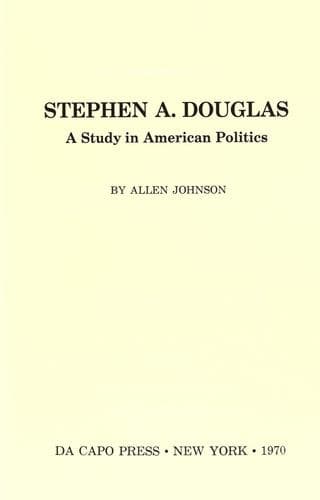
Stephen A. Douglas: A Study in American PoliticsJohnson, Allen
History
Stephen A. Douglas: A Study in American Politics
Johnson, Allen
Douglas, Stephen A. (Stephen Arnold), 1813-1861
In the debates on the Omnibus Bill, Douglas reiterated his theory of
non-interference with the right of the people to legislate for
themselves on the question of slavery. He was now forced to further
interesting assertions by some pointed questions from Senator Davis of
Mississippi. "The Senator says that the inhabitants of a territory
have a right to decide what their institutions shall be. When? By what
authority? How many of them?" Douglas replied: "Without determining
the precise number, I will assume that the right ought to accrue to
the people at the moment they have enough to constitute a
government.... Your bill concedes that a representative government is
necessary--a government founded upon the principles of popular
sovereignty, and the right of the people to enact their own laws; and
for this reason you give them a legislature constituted of two
branches, like the legislatures of the different States and
Territories of the Union; you confer upon them the right to legislate
upon all rightful subjects of legislation, except negroes. Why except
negroes?"[356] Forced to a further explanation, he added, "I am not,
therefore, prepared to say that under the constitution, we have not
the power to pass laws excluding negro slaves from the territories....
But I do say that, if left to myself to carry out my own opinions, I
would leave the whole subject to the people of the territories
themselves.... I believe it is one of those rights to be conceded to
the territories the moment they have governments and legislatures
established for them."[357] In short, this was a policy dictated by
expediency, and not--as yet--by any constitutional necessity. Douglas
was not yet ready to abandon the high national ground of supreme,
Federal control over the Territories.
But the restrictive clause in the territorial bills satisfied the
radical Southerners as little as it pleased Douglas. Berrien wished to
make the clause more precise by forbidding the territorial
legislatures "to establish or prohibit African slavery"; but Hale,
with his preternatural keenness for the supposed intrigues of the
slave power, believed that even with these restrictions the
legislatures might still recognize slavery as an already established
institution; and he therefore moved to add the word "allow." Douglas
voted consistently; first against Berrien's amendment, and then, when
it carried, for Hale's, hoping thereby to discredit the former.[358]
Douglas's own amendment removing all restrictions, was voted
down.[359] True to his instructions, he voted for Seward's proposition
to impose the Wilmot Proviso upon the Territories, but he was happy to
find himself in the minority.[360] And so the battle went on,
threatening to end in a draw.
Public-domain text, read in full here on John Shaqi.
Reviews
Reviews
No reviews yet
Be the first to share your thoughts on this work.
Elsewhere in the archive
Join the Discussion
Join the discussion
Sign in to leave a comment or review.
Sign InorCreate an account