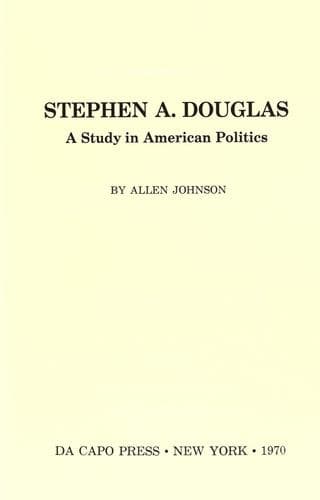
Stephen A. Douglas: A Study in American PoliticsJohnson, Allen
History
Stephen A. Douglas: A Study in American Politics
Johnson, Allen
Douglas, Stephen A. (Stephen Arnold), 1813-1861
When Douglas reached Chicago, immediately after the adjournment of
Congress, he found the city in an uproar. The strong anti-slavery
sentiment of the community had been outraged by the Fugitive Slave
Law. Reflecting the popular indignation, the Common Council had
adopted resolutions condemning the act as a violation of the
Constitution and a transgression of the laws of God. Those senators
and representatives who voted for the bill, or "who basely sneaked
away from their seats and thereby evaded the question," were
stigmatized as "fit only to be ranked with the traitors, Benedict
Arnold and Judas Iscariot." This was indeed a sorry home-coming for
one who believed himself entitled to honors.
Learning that a mass-meeting was about to indorse the action of the
city fathers, Douglas determined to face his detractors and meet their
charges. Entering the hall while the meeting was in progress, he
mounted the platform, and announced that on the following evening he
would publicly defend all the measures of adjustment. He was greeted
with hisses and jeers for his pains; but in the end he had the
satisfaction of securing an adjournment until his defense had been
heard.
It was infinitely to his credit that when he confronted a hostile
audience on the next evening, he stooped to no cheap devices to divert
resentment, but sought to approve his course to the sober
intelligence of his hearers.[370] It is doubtful if the Fugitive Slave
Law ever found a more skillful defender. The spirit in which he met
his critics was admirably calculated to disarm prejudice. Come and let
us reason together, was his plea. Without any attempt to ignore the
most obnoxious parts of the act, he passed directly to the discussion
of the clauses which apparently denied the writ of _habeas corpus_ and
trial by jury to the fugitive from service. He reminded his hearers
that this act was supplementary to the Act of 1793. No one had found
fault with the earlier act because it had denied these rights. Both
acts, in fact, were silent on these points; yet in neither case was
silence to be construed as a denial of constitutional obligations. On
the contrary, they must be assumed to continue in full force under the
act. Misapprehension arose in these matters, because the recovery of
the fugitive slave was not viewed as a process of extradition. The act
provided for the return of the alleged slave to the State from which
he had fled. Trial of the facts by jury would then follow under the
laws of the State, just as the fugitive from justice would be tried in
the State where the alleged crime had been committed. The testimony
before the original court making the requisition, would necessarily be
_ex parte_, as in the case of the escaped criminal; but this did not
prevent a fair trial on return of the fugitive. Regarding the question
of establishing the identity of the apprehended person with the
fugitive described in the record, Douglas asserted that the terms of
Public-domain text, read in full here on John Shaqi.
Reviews
Reviews
No reviews yet
Be the first to share your thoughts on this work.
Elsewhere in the archive
Join the Discussion
Join the discussion
Sign in to leave a comment or review.
Sign InorCreate an account