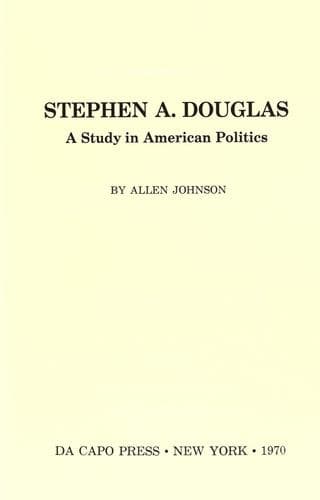
Stephen A. Douglas: A Study in American PoliticsJohnson, Allen
History
Stephen A. Douglas: A Study in American Politics
Johnson, Allen
Douglas, Stephen A. (Stephen Arnold), 1813-1861
If Douglas had been disposed to work out his political prospects by
mathematical computation, he would have arrived at some interesting
conclusions from the balloting in the convention. Indeed, very
probably he drew some deductions in his own intuitive way, without any
adventitious aid. Of the three rivals, Cass received the most widely
distributed vote, although Douglas received votes from as many States.
While they drew votes from twenty-one States, Buchanan received votes
from only fifteen. Cass and Douglas obtained their highest percentages
of votes from the West; Buchanan found his strongest support in the
South. Douglas and Cass received least support in the Middle States;
Buchanan had no votes from the West. But while Cass had, on his
highest total, thirty per centum of the whole vote of the Middle
States, Douglas was relatively weak in the Middle States rather than
in the South. On the basis of these figures, it is impossible to
justify the statement that he could expect nothing in future from New
England and Pennsylvania, but would look to the South for support for
the presidency.[392] On the contrary, one would say that his strong
New England following would act as an equipoise, preventing too great
a dip toward the Southern end of the scales. Besides, Douglas's hold
on his own constituents and the West was contingent upon the favor of
the strong New England element in the Northwest. If this convention
taught Douglas anything, it must have convinced him that narrow,
sectional policies and undue favor to the South would never land him
in the White House. To win the prize which he frankly coveted, he must
grow in the national confidence, and not merely in the favor of a
single section, however powerful.[393]
Public-domain text, read in full here on John Shaqi.
Reviews
Reviews
No reviews yet
Be the first to share your thoughts on this work.
Elsewhere in the archive
Join the Discussion
Join the discussion
Sign in to leave a comment or review.
Sign InorCreate an account