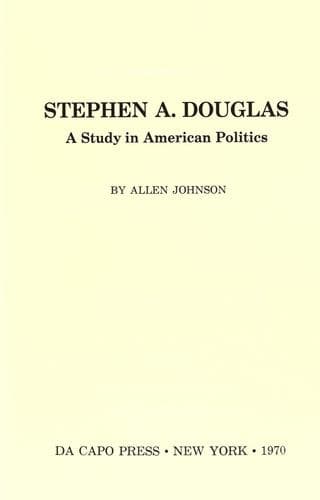
Stephen A. Douglas: A Study in American PoliticsJohnson, Allen
History
Stephen A. Douglas: A Study in American Politics
Johnson, Allen
Douglas, Stephen A. (Stephen Arnold), 1813-1861
Pledges aside, Douglas was bound to give vigorous aid to the party
candidates. His term as senator was about to expire. His own fortunes
were inseparably connected with those of his party in Illinois. The
Washington _Union_ printed a list of his campaign engagements,
remarking with evident satisfaction that Judge Douglas was "in the
field with his armor on." His itinerary reached from Virginia to
Arkansas, and from New York to the interior counties of his own State.
Stray items from a speech in Richmond suggest the tenuous quality of
these campaign utterances. It was quite clear to his mind that General
Scott's acceptance of the Whig nomination could not have been written
by that manly soldier, but by _Politician_ Scott under the control of
_General_ Seward. Was it wise to convert a good general into a bad
president? Could it be true that Scott had promised the entire
patronage of his administration to the Whigs? Why, "there had never
been a Democratic administration in this Union that did not retain at
least one-third of their political opponents in office!"[394] And yet,
when Pierce had been elected, Douglas could say publicly, without so
much as a blush, that Democrats must now have the offices. "For every
Whig removed there should be a competent Democrat put in his place ...
The best men should be selected, and everybody knows that the best men
voted for Pierce and King."[395]
The outcome of the elections in Illinois was gratifying save in one
particular. In consequence of the redistricting of the State, the
Whigs had increased the number of their representatives in Congress.
But the re-election of Douglas was assured.[396] His hold upon his
constituency was unshaken. With right good will he participated in the
Democratic celebration at Washington. As an influential personage in
Democratic councils he was called upon to sketch in broad lines what
he deemed to be sound Democratic policy; but only a casual reference
to Cuba redeemed his speech from the commonplace. "Whenever the people
of Cuba show themselves worthy of freedom by asserting and maintaining
independence, and apply for annexation, they ought to be annexed;
whenever Spain is ready to sell Cuba, with the consent of its
inhabitants, we ought to accept it on fair terms; and if Spain should
transfer Cuba to England or any other European power, we should take
and hold Cuba anyhow."[397]
Public-domain text, read in full here on John Shaqi.
Reviews
Reviews
No reviews yet
Be the first to share your thoughts on this work.
Elsewhere in the archive
Join the Discussion
Join the discussion
Sign in to leave a comment or review.
Sign InorCreate an account