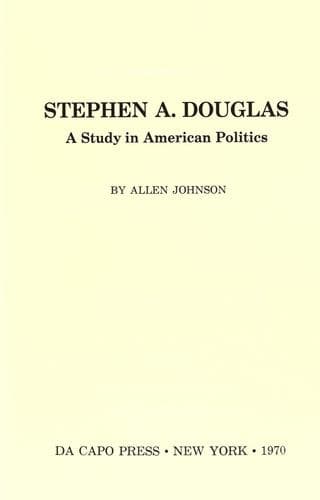
Stephen A. Douglas: A Study in American PoliticsJohnson, Allen
History
Stephen A. Douglas: A Study in American Politics
Johnson, Allen
Douglas, Stephen A. (Stephen Arnold), 1813-1861
Behind this imbroglio lay an intricate diplomatic history which can
be here only briefly recapitulated. The interest of the United States
in the Central American States dated from the discovery of gold in
California. The value of the control of the means of transportation
across the isthmus at Nicaragua became increasingly clear, as the gold
seekers sought that route to the Pacific coast. In the latter days of
his administration, President Polk had sent one Elijah Hise to
cultivate friendly relations with the Central American States and to
offset the paramount influence of Great Britain in that region. Great
Britain was already in possession of the colony of Belize and was
exercising an ill-defined protectorate over the Mosquito Indians on
the eastern coast of Nicaragua. In his ardor to serve American
interests, Hise exceeded his instructions and secured a treaty with
Nicaragua, which gave to the United States exclusive privileges over
the route of the proposed canal, on condition that the sovereignty of
Nicaragua were guaranteed. The incoming Whig administration would have
nothing to do with the Hise _entente_, preferring to dispatch its own
agent to Central America. Though Squier succeeded in negotiating a
more acceptable treaty, the new Secretary of State, Clayton, was
disposed to come to an understanding with Great Britain. The outcome
of these prolonged negotiations was the famous Clayton-Bulwer treaty,
by which both countries agreed to further the construction of a ship
canal across the isthmus through Nicaragua, and to guarantee its
neutrality. Other countries were invited to join in securing the
neutrality of this and other regions where canals might be
constructed. Both Great Britain and the United States explicitly
renounced any "dominion over Nicaragua, Costa Rica, the Mosquito
coast or any part of Central America."[399]
The opposition would have been something less than human, if they had
not seized upon the occasion to discredit the outgoing administration.
Cass had already introduced a resolution reaffirming the terms of the
famous Monroe message respecting European colonization in America, and
thus furnishing the pretext for partisan attacks upon Secretary of
State Clayton. But Cass unwittingly exposed his own head to a sidelong
blow from his Democratic rival from Illinois, who affected the role of
Young America once more.
Public-domain text, read in full here on John Shaqi.
Reviews
Reviews
No reviews yet
Be the first to share your thoughts on this work.
Elsewhere in the archive
Join the Discussion
Join the discussion
Sign in to leave a comment or review.
Sign InorCreate an account