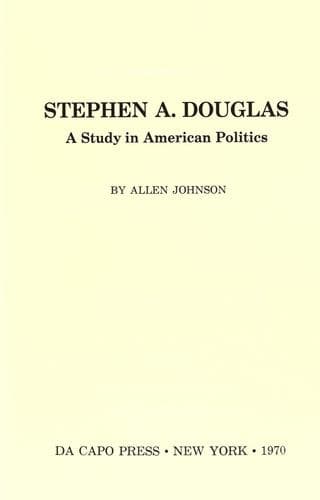
Stephen A. Douglas: A Study in American PoliticsJohnson, Allen
History
Stephen A. Douglas: A Study in American Politics
Johnson, Allen
Douglas, Stephen A. (Stephen Arnold), 1813-1861
Ambition and a buoyant optimism seemed likely to make Douglas more
than ever a power in Democratic politics, when a personal bereavement
changed the current of his life. His young wife whom he adored, the
mother of his two boys, died shortly after the new year. For the
moment he was overwhelmed; and when he again took his place in the
Senate, his colleagues remarked in him a bitterness and acerbity of
temper which was not wonted. One hostage that he had given to Fortune
had been taken away, and a certain recklessness took possession of
him. He grew careless in his personal habits, slovenly in his dress,
disregardful of his associates, and if possible more vehemently
partisan in his public utterances.
It was particularly regrettable that, while Douglas was passing
through this domestic tragedy, he should have been drawn into a
controversy relating to British claims in Central America. It was
rumored that Great Britain, in apparent violation of the terms of the
Clayton-Bulwer treaty, had taken possession of certain islands in the
Bay of Honduras and erected them into the colony of "the Bay Islands."
On the heels of this rumor came news that aroused widespread
indignation. A British man-of-war had fired upon an American steamer,
which had refused to pay port dues on entering the harbor of Greytown.
Over this city, strategically located at the mouth of the San Juan
River, Great Britain exercised an ill-disguised control as part of the
Mosquito protectorate.
In the midst of the excited debate which immediately followed in
Congress, Cass astonished everybody by producing the memorandum which
Bulwer had given Clayton just before the signing of the treaty.[398]
In this remarkable note, the British ambassador stated that his
government did not wish to be understood as renouncing its existing
claims to Her Majesty's settlement at Honduras and "its dependencies."
And Clayton seemed to have admitted the force of this reservation. For
his part, Cass made haste to say, he wished the Senate distinctly to
understand that when he had voted for the treaty, he believed Great
Britain was thereby prevented from establishing any such dependency.
His object--and he had supposed it to be the object of the treaty--was
to sweep away all British claims to Central America.
Public-domain text, read in full here on John Shaqi.
Reviews
Reviews
No reviews yet
Be the first to share your thoughts on this work.
Elsewhere in the archive
Join the Discussion
Join the discussion
Sign in to leave a comment or review.
Sign InorCreate an account