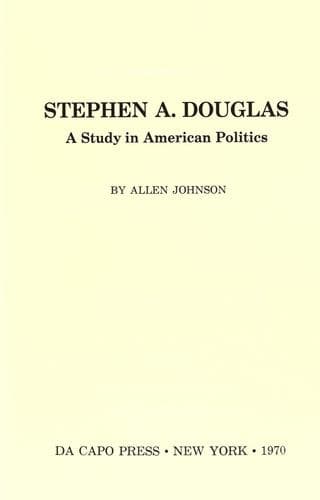
Stephen A. Douglas: A Study in American Politics — John Shaqi
Stephen A. Douglas: A Study in American PoliticsJohnson, Allen
History
Stephen A. Douglas: A Study in American Politics
Johnson, Allen
Douglas, Stephen A. (Stephen Arnold), 1813-1861
The next issue of the _Patriot_, the local Whig paper, devoted two
columns to the speech of this young Democratic upstart; and for weeks
thereafter the editor flayed him on all possible occasions. The result
was such an enviable notoriety for the young attorney among Whigs and
such fame among Democrats, that he received collection demands to the
amount of thousands of dollars from persons whom he had never seen or
known. In after years, looking back on these beginnings, he used to
wonder whether he ought not to have paid the editor of the _Patriot_
for his abuse, according to the usual advertising rates.[40] The
political outcome was not in every respect so gratifying. The
Democratic county ticket was elected and a Democratic congressman from
the district; but the Whigs elected their candidate for governor.
A factional quarrel among members of his own party gave Douglass his
reward for services to the cause of Democracy, and his first political
office. Captain John Wyatt nursed a grudge against John J. Hardin,
Esq., who had been elected State's attorney for the district through
his influence, but who had subsequently proved ungrateful. Wyatt had
been re-elected member of the legislature, however, in spite of
Hardin's opposition, and now wished to revenge himself, by ousting
Hardin from his office. With this end in view, Wyatt had Douglass
draft a bill making the State's attorneys elective by the legislature,
instead of subject to the governor's appointment. Since the new
governor was a Whig, he could not be used by the Democrats. The bill
met with bitter opposition, for it was alleged that it had no other
purpose than to vacate Hardin's office for the benefit of Douglass.
This was solemnly denied;[41] but when the bill had been declared
unconstitutional by the Council of Revision, Douglass' friends made
desperate exertions to pass the bill over the veto, with the now
openly avowed purpose to elect him to the office. The bill passed, and
on the 10th of February, 1835, the legislature in joint session
elected the boyish lawyer State's attorney for the first judicial
district, by a majority of four votes over an attorney of experience
and recognized merit. It is possible, as Douglass afterward averred,
that he neither coveted the office nor believed himself fitted for it;
and that his judgment was overruled by his friends. But he accepted
the office, nevertheless.
Public-domain text, read in full here on John Shaqi.
Reviews
Reviews
No reviews yet
Be the first to share your thoughts on this work.
Join the Discussion
Join the discussion
Sign in to leave a comment or review.
Sign InorCreate an account