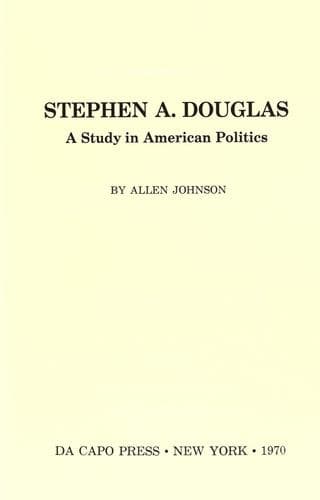
Stephen A. Douglas: A Study in American PoliticsJohnson, Allen
History
Stephen A. Douglas: A Study in American Politics
Johnson, Allen
Douglas, Stephen A. (Stephen Arnold), 1813-1861
The regrettable aspect of Douglas's course is his attempt to nullify
the Missouri Compromise by subtle indirection. This was the device of
a shifty politician, trying to avert suspicion and public alarm by
clever ambiguities. That he really believed a new principle had been
substituted for an old one, in dealing with the Territories, does not
extenuate the offense, for not even he had ventured to assert in 1850,
that the compromises of that year had in any wise disturbed the status
of the great, unorganized area to which Congress had applied the
restrictive proviso of 1820. Besides, only so recently as 1849, he had
said, with all the emphasis of sincerity, that the compromise had
"become canonized in the hearts of the American people, as a sacred
thing, which no ruthless hand would ever be reckless enough to
disturb." And while he then opposed the extension of the principle to
new Territories, he believed that it had been "deliberately
incorporated into our legislation as a solemn and sacred
compromise."[450]
By this time Douglas must have been aware of the covert purpose of
Atchison and others to secure the repeal of the Missouri Compromise,
though he hoped that they would acquiesce in his mode of doing it. He
was evidently not prepared for the bold move which certain of the
senators from slave States were contemplating.[451] He was therefore
startled by an amendment which Dixon of Kentucky offered on January
16th, to the effect that the restrictive clause of the Act of 1820
should not be so construed as to apply to Nebraska or any other
Territory; "but that the citizens of the several States or territories
shall be at liberty to take and hold their slaves within any of the
territories of the United States or of the States to be formed
therefrom," as if the Missouri Act had never been passed. Douglas at
once left his seat to remonstrate with Dixon, who was on the Whig side
of the Senate chamber. He disliked the amendment, not so much because
it wiped out the Missouri Compromise as because it seemed
"affirmatively to legislate slavery into the Territory."[452] Knowing
Dixon to be a supporter of the compromise measures of 1850, Douglas
begged him not to thwart the work of his committee, which was trying
in good faith to apply the cardinal features of those measures to
Nebraska. The latter part of Dixon's amendment could hardly be
harmonized with the principle of congressional non-intervention.[453]
Public-domain text, read in full here on John Shaqi.
Reviews
Reviews
No reviews yet
Be the first to share your thoughts on this work.
Elsewhere in the archive
Join the Discussion
Join the discussion
Sign in to leave a comment or review.
Sign InorCreate an account