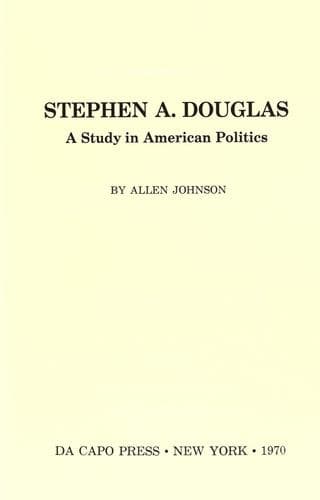
Stephen A. Douglas: A Study in American PoliticsJohnson, Allen
History
Stephen A. Douglas: A Study in American Politics
Johnson, Allen
Douglas, Stephen A. (Stephen Arnold), 1813-1861
There seems to be no reason to doubt that Dixon moved in this matter on
his own initiative;[454] but he was a friend to Atchison and he could
not have been wholly ignorant of the Missouri factional quarrel.[455]
To be sure, Dixon was a Whig, but Southern Whigs and Democrats were at
one in desiring expansion for the peculiar institution of their
section. Pressure was now brought to bear upon Douglas to incorporate
the direct repeal of the compromise in the Nebraska bill.[456] He
objected strongly, foreseeing no doubt the storm of protest which would
burst over his head in the North.[457] Still, if he could unite the
party on the principle of non-intervention with slavery in the
Territories, the risk of temporary unpopularity would be worth taking.
No doubt personal ambition played its part in forming his purpose, but
party considerations swayed him most powerfully.[458] He witnessed with
no little apprehension the divergence between the Northern and Southern
wings of the party; he had commented in private upon "the distracted
condition" of the party and the need of perpetuating its principles and
consolidating its power. Might this not be his opportunity?
On Sunday morning, January 22d, just before the hour for church,
Douglas, with several of his colleagues, called upon the Secretary of
War, Davis, stating that the Committees on Territories of the Senate
and House had agreed upon a bill, for which the President's approval
was desired. They pressed for an immediate interview inasmuch as they
desired to report the bill on the morrow. Somewhat reluctantly, Davis
arranged an interview for them, though the President was not in the
habit of receiving visitors on Sunday. Yielding to their request,
President Pierce took the proposed bill under consideration, giving
careful heed to all explanations; and when they were done, both he
and his influential secretary promised their support.[459]
What was this momentous bill to which the President thus pledged
himself? The title indicated the most striking feature. There were now
to be two Territories: Kansas and Nebraska. Bedded in the heart of
Section 14, however, was a still more important provision which
announced that the prohibition of slavery in the Act of 1820 had been
"superseded by the principles of the legislation of eighteen hundred
and fifty, commonly called the compromise measures," and was therefore
"inoperative."
It has been commonly believed that Douglas contemplated making one
free and one slave State out of the Nebraska region. His own simple
explanation is far more credible: the two Johnsons had petitioned for
a division of the Territory along the fortieth parallel, and both the
Iowa and Missouri delegations believed that their local interests
would be better served by two Territories.[460]
Public-domain text, read in full here on John Shaqi.
Reviews
Reviews
No reviews yet
Be the first to share your thoughts on this work.
Elsewhere in the archive
Join the Discussion
Join the discussion
Sign in to leave a comment or review.
Sign InorCreate an account