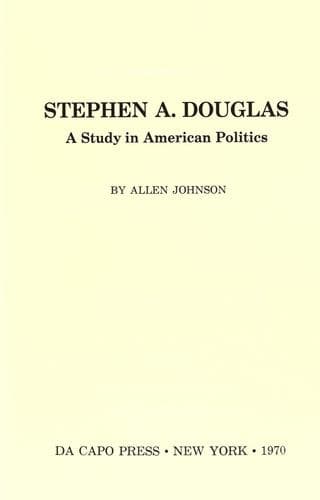
Stephen A. Douglas: A Study in American PoliticsJohnson, Allen
History
Stephen A. Douglas: A Study in American Politics
Johnson, Allen
Douglas, Stephen A. (Stephen Arnold), 1813-1861
While the administration publicly wheeled into line behind Douglas,
the "Appeal of the Independent Democrats in Congress to the People of
the United States" summoned the anti-slavery elements to join battle
in behalf of the Missouri Compromise. This memorable document had been
written by Chase of Ohio and dated January 19th, but a postscript was
added after the revised Kansas-Nebraska bill had been reported.[465]
It was an adroitly worded paper. History has falsified many of its
predictions; history then controverted many of its assumptions; but it
was colored with strong emotion and had the ring of righteous
indignation.
The gist of the appeal was contained in two clauses, one of which
declared that the Nebraska bill would open all the unorganized
territory of the Union to the ingress of slavery; the other arraigned
the bill as "a gross violation of a sacred pledge; as a criminal
betrayal of precious rights." In ominous words, fellow citizens were
besought to observe how the blight of slavery would settle upon all
this land, if this bill should become a law. Christians and Christian
ministers were implored to interpose. "Let all protest, earnestly and
emphatically, by correspondence, through the press, by memorials, by
resolutions of public meetings and legislative bodies, and in whatever
other mode may seem expedient, against this enormous crime." In the
postscript Douglas received personal mention. "Not a man in Congress
or out of Congress, in 1850, pretended that the compromise measures
would repeal the Missouri prohibition. Mr. Douglas himself never
advanced such a pretence until this session. His own Nebraska bill, of
last session, rejected it. It is a sheer afterthought. To declare the
prohibition inoperative, may, indeed, have effect in law as a repeal,
but it is a most discreditable way of reaching the object. Will the
people permit their dearest interests to be thus made the mere hazards
of a presidential game, and destroyed by false facts and false
inferences?"[466]
This attack roused the tiger in the Senator from Illinois. When he
addressed the Senate on January 30th, he labored under ill-repressed
anger. Even in the expurgated columns of the _Congressional Globe_
enough stinging personalities appeared to make his friends regretful.
What excited his wrath particularly was that Chase and Sumner had
asked for a postponement of discussion, in order to examine the bill,
and then, in the interval, had sent out their indictment of the
author. It was certainly unworthy of him to taunt them with having
desecrated the Sabbath day by writing their plea. The charge was not
only puerile but amusing, when one considers how Douglas himself was
observing that particular Sabbath.
Public-domain text, read in full here on John Shaqi.
Reviews
Reviews
No reviews yet
Be the first to share your thoughts on this work.
Elsewhere in the archive
Join the Discussion
Join the discussion
Sign in to leave a comment or review.
Sign InorCreate an account