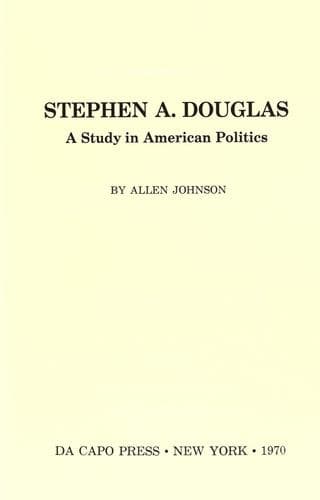
Stephen A. Douglas: A Study in American PoliticsJohnson, Allen
History
Stephen A. Douglas: A Study in American Politics
Johnson, Allen
Douglas, Stephen A. (Stephen Arnold), 1813-1861
It was comparatively easy to question and disprove the unqualified
statement of the _Appeal_, that "the original settled policy of the
United States was non-extension of slavery." Less convincing was
Douglas's attempt to prove that the Missouri Compromise was expressly
annulled in 1850, when portions of Texas and of the former Spanish
province of Louisiana were added to New Mexico, and also a part of the
province of Louisiana was joined to Utah. Douglas was in the main
correct as to geographical data; but he could not, and did not, prove
that the members of the Thirty-first Congress purposed also to revoke
the Missouri Compromise restriction in all the other unorganized
Territories. This contention was one of those _non-sequiturs_ of which
Douglas, in the heat of argument, was too often guilty. Still more
regrettable, because it seemed to convict him of sophistry, was the
mode by which he sought to evade the charge of the _Appeal_, that the
act organizing New Mexico and settling the boundary of Texas had
reaffirmed the Missouri Compromise. To establish his point he had to
assume that _all_ the land cut off from Texas north of 36 deg. 30', was
added to New Mexico, thus leaving nothing to which the slavery
restriction, reaffirmed in the act of 1850, could apply. But Chase
afterward invalidated this assumption and Douglas was forced so to
qualify his original statement as to yield the point. This was a
damaging admission and prejudiced his cause before the country. But
when he brought his wide knowledge of American colonization to bear
upon the concrete problems of governmental policy, his grasp of the
situation was masterly.
"Let me ask you where you have succeeded in excluding slavery by an
act of Congress from one inch of American soil? You may tell me that
you did it in the northwest territory by the ordinance of 1787. I
will show you by the history of the country that you did not
accomplish any such thing. You prohibited slavery there by law, but
you did not exclude it in fact.... I know of but one territory of the
United States where slavery does exist, and that one is where you have
prohibited it by law, and it is in this very Nebraska Territory. In
defiance of the eighth section of the act of 1820, in defiance of
Congressional dictation, there have been, not many, but a few slaves
introduced.... I have no doubt that whether you organize the territory
of Nebraska or not this will continue for some time to come.... But
when settlers rush in--when labor becomes plenty, and therefore cheap,
in that climate, with its productions, it is worse than folly to think
of its being a slave-holding country.... I do not like, I never did
like, the system of legislation on our part, by which a geographical
line, in violation of the laws of nature, and climate, and soil, and
of the laws of God, should be run to establish institutions for a
people."[467]
Public-domain text, read in full here on John Shaqi.
Reviews
Reviews
No reviews yet
Be the first to share your thoughts on this work.
Elsewhere in the archive
Join the Discussion
Join the discussion
Sign in to leave a comment or review.
Sign InorCreate an account