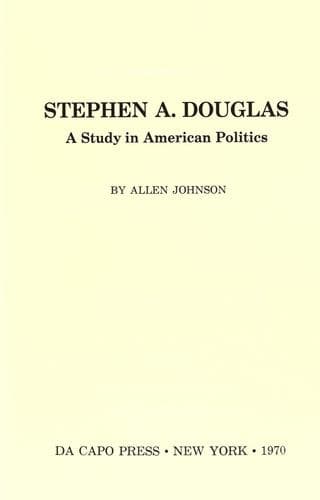
Stephen A. Douglas: A Study in American PoliticsJohnson, Allen
History
Stephen A. Douglas: A Study in American Politics
Johnson, Allen
Douglas, Stephen A. (Stephen Arnold), 1813-1861
This part of the bill had now assumed its final form. _Subject only to
the Constitution of the United States_. The words were clear; but
what was their implication? A few days later, Douglas wrote to his
Springfield confidant, "The Democratic party is committed in the most
solemn manner to the principle of congressional non-interference with
slavery in the States and Territories. The administration is committed
to the Nebraska bill and will stand by it at all hazards.... The
principle of this bill will form the test of parties, and the only
alternative is either to stand with the Democracy or rally under
Seward, John Van Buren & Co.... We shall pass the Nebraska bill in
both Houses by decisive majorities and the party will then be stronger
than ever, for it will be united upon principle."[475]
Yet there were dissentient opinions. What was in the background of
Southern consciousness was expressed bluntly by Brown of Mississippi,
who refused to admit that the right of the people of a Territory to
regulate their domestic institutions, including slavery, was a right
to destroy. "If I thought in voting for the bill as it now stands, I
was conceding the right of the people in the territory, during their
territorial existence, to exclude slavery, I would withhold my
vote.... It leaves the question where I am quite willing it should be
left--to the ultimate decision of the courts."[476] Chase also, though
for widely different reasons, disputed the power of the people of a
Territory to exclude slavery, under the terms of this bill.[477] And
Senator Clayton pointed out that non-interference was a delusion, so
long as it lay within the power of any member of Congress to move a
repeal of any and every territorial law which came up for approval,
for the bill expressly provided for congressional approval of
territorial laws.[478]
Douglas was irritated by these aspersions on his cherished principle.
He declared again, in defiant tones, that the right of the people to
permit or exclude was clearly included in the wording of the measure.
He was not willing to be lectured about indirectness. He had heard
cavil enough about his amendments.[479]
In the course of a debate on March 2d, another unforeseen difficulty
loomed up in the distance. If the Missouri Compromise were repealed,
would not the original laws of Louisiana, which legalized slavery, be
revived? How then could the people of the Territories be free to
legislate against slavery? It was a knotty question, testing the best
legal minds in the Senate; and it was dispatched only by an amendment
which stated that the repeal of the Missouri Compromise should not
revive any antecedent law respecting slavery.[480]
Public-domain text, read in full here on John Shaqi.
Reviews
Reviews
No reviews yet
Be the first to share your thoughts on this work.
Elsewhere in the archive
Join the Discussion
Join the discussion
Sign in to leave a comment or review.
Sign InorCreate an account