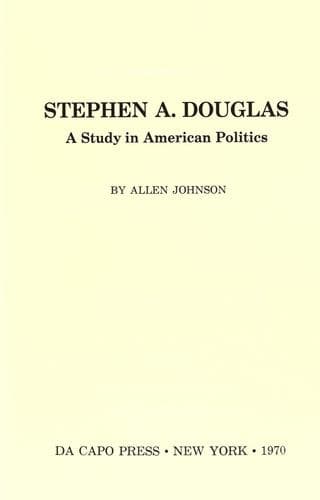
Stephen A. Douglas: A Study in American PoliticsJohnson, Allen
History
Stephen A. Douglas: A Study in American Politics
Johnson, Allen
Douglas, Stephen A. (Stephen Arnold), 1813-1861
The objection raised by Clayton still remained: how was it possible to
reconcile congressional non-intervention with the right of Congress to
revise territorial laws? Now Douglas had never contended that the
right of the people to self-government in the Territories was complete
as against the power of Congress. He had never sought to confer upon
them more than a relative degree of self-government--"the power to
regulate their domestic institutions." He could not, and he did not,
deny the truth and awkwardness of Clayton's contention. Where, then,
demanded his critics, was the guarantee that the Kansas-Nebraska bill
would banish the slavery controversies from Congress? This challenge
could not go unanswered. Without other explanation, Douglas moved to
strike out the provision requiring all territorial laws to be
submitted to Congress.[481] But did this divest Congress of the power
of revision? On this point Douglas preserved a discreet silence.
Recognizing also the incongruity of giving an absolute veto power to a
governor who would be appointed by the President, Douglas proposed a
suspensive, in place of an absolute, veto power. A two-thirds vote in
each branch of the territorial legislature would override the
governor's negative.[482] Chase now tried to push Douglas one step
farther on the same slippery road. "Can it be said," he asked, "that
the people of a territory will enjoy self-government when they elect
only their legislators and are subject to a governor, judges, and a
secretary appointed by the Federal Executive?" He would amend by
making all these officers elective.[483] Douglas extricated himself
from this predicament by saying simply that these officers were
charged with federal rather than with territorial duties.[484] The
amendment was promptly negatived. Yet seven years later, this very
proposition was indorsed by Douglas under peculiar circumstances. At
this time in 1854, it would have effected nothing short of a
revolution in American territorial policy; and it might have altered
the whole history of Kansas.
Public-domain text, read in full here on John Shaqi.
Reviews
Reviews
No reviews yet
Be the first to share your thoughts on this work.
Elsewhere in the archive
Join the Discussion
Join the discussion
Sign in to leave a comment or review.
Sign InorCreate an account