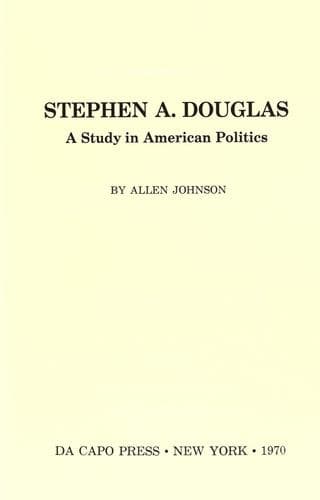
Stephen A. Douglas: A Study in American PoliticsJohnson, Allen
History
Stephen A. Douglas: A Study in American Politics
Johnson, Allen
Douglas, Stephen A. (Stephen Arnold), 1813-1861
Politically as well as socially, Illinois was in a transitional stage.
Although political parties existed, they were rather loose
associations of men holding similar political convictions than parties
in the modern sense with permanent organs of control. He who would
might stand for office, either announcing his own candidacy in the
newspapers, or if his modesty forbade this course, causing such an
announcement to be made by "many voters." In benighted districts,
where the light of the press did not shine, the candidate offered
himself in person. Even after the advent of Andrew Jackson in national
politics, allegiance to party was so far subordinated to personal
ambition, that it was no uncommon occurrence for several candidates
from each party to enter the lists.[45] From the point of view of
party, this practice was strategically faulty, since there was always
the possibility that the opposing party might unite on a single
candidate. What was needed to insure the success of party was the
rationale of an army. But organization was abhorrent to people so
tenacious of their personal freedom as Illinoisans, because
organization necessitated the subordination of the individual to the
centralized authority of the group. To the average man organization
spelled dictation.
The first step in the effective control of nominations by party in
Illinois, was taken by certain Democrats, foremost among whom was S.A.
Douglas, Esq. His rise as a politician, indeed, coincides with this
development of party organization and machinery. The movement began
sporadically in several counties. At the instance of Douglas and his
friend Brooks of the _News_, the Democrats of Morgan County put
themselves on record as favoring a State convention to choose
delegates to the national convention of 1836.[46] County after county
adopted the suggestion, until the movement culminated in a
well-attended convention at Vandalia in April, 1835. Not all counties
were represented, to be sure, and no permanent organization was
effected; but provision was made for a second convention in December,
to nominate presidential electors.[47] Among the delegates from Morgan
County in this December convention was Douglas, burning with zeal for
the consolidation of his party. Signs were not wanting that he was in
league with other zealots to execute a sort of _coup d'etat_ within
the party. Early in the session, one Ebenezer Peck, recently from
Canada, boldly proposed that the convention should proceed to nominate
not only presidential electors but candidates for State offices as
well. A storm of protests broke upon his head, and for the moment he
was silenced; but on the second day, he and his confidants succeeded
in precipitating a general discussion of the convention system.
Peck--contemptuously styled "the Canadian" by his enemies--secured the
floor and launched upon a vigorous defense of the nominating
convention as a piece of party machinery. He thought it absurd to talk
Public-domain text, read in full here on John Shaqi.
Reviews
Reviews
No reviews yet
Be the first to share your thoughts on this work.
Join the Discussion
Join the discussion
Sign in to leave a comment or review.
Sign InorCreate an account