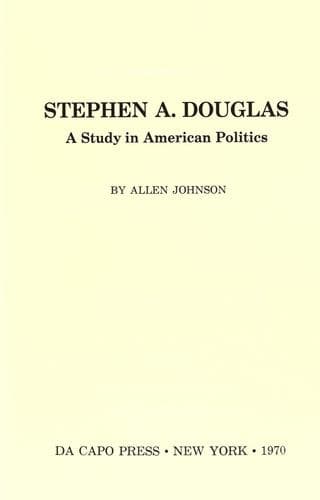
Stephen A. Douglas: A Study in American PoliticsJohnson, Allen
History
Stephen A. Douglas: A Study in American Politics
Johnson, Allen
Douglas, Stephen A. (Stephen Arnold), 1813-1861
There was, indeed, enough of confusion in some States to give color to
such assertions. Taken collectively, however, the elections indicated
unmistakably a widespread revulsion against the administration of
President Pierce; and it was folly to contend that the Kansas-Nebraska
bill had not been the prime cause of popular resentment. Douglas was
so constituted temperamentally that he both could not, and would not,
confront the situation fairly and squarely. This want of sensitiveness
to the force of ethical convictions stirring the masses, is the most
conspicuous and regrettable aspect of his statecraft. Personally
Douglas had a high sense of honor and duty; in private affairs he was
scrupulously honest; and if at times he was shifty in politics, he
played the game with quite as much fairness as those contemporary
politicians who boasted of the integrity of their motives. He
preferred to be frank; he meant to deal justly by all men. Even so, he
failed to understand the impelling power of those moral ideals which
border on the unattainable. For the transcendentalist in politics and
philanthropy, he had only contempt. The propulsive force of an idea in
his own mind depended wholly upon its appeal to his practical
judgment. His was the philosophy of the attainable. Results that were
approximately just and fair satisfied him. He was not disposed to
sacrifice immediate advantage to future gain. His Celtic temperament
made him think rapidly; and what imagination failed to supply, quick
wit made good.
When, then, under the pressure of conditions for which he was not
responsible, he yielded to the demand for a repeal of the Missouri
Compromise, he failed to foresee that revulsion of moral sentiment
that swept over the North. It was perfectly clear to his mind, that
historically the prohibition of slavery by Federal law had had far
less practical effect than the North believed. He was convinced that
nearly all, if not all, of the great West was dedicated to freedom by
a law which transcended any human enactment. Why, then, hold to a mere
form, when the substance could be otherwise secured? Why should
Northerner affront Southerner by imperious demands, when the same end
might be attained by a compromise which would not cost either dear?
Possibly he was not unwilling to let New Mexico become slave
Territory, if the greater Northwest should become free by the
operation of the same principle. Besides, there was the very tangible
advantage of holding his party together by a sensible agreement, for
the sake of which each faction yielded something.
Public-domain text, read in full here on John Shaqi.
Reviews
Reviews
No reviews yet
Be the first to share your thoughts on this work.
Elsewhere in the archive
Join the Discussion
Join the discussion
Sign in to leave a comment or review.
Sign InorCreate an account