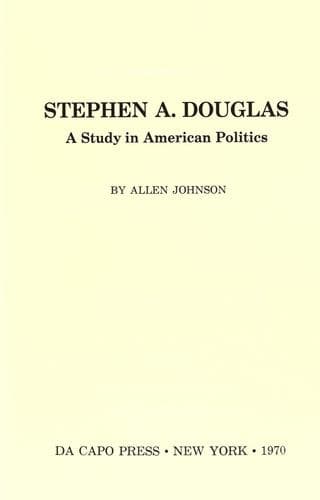
Stephen A. Douglas: A Study in American PoliticsJohnson, Allen
History
Stephen A. Douglas: A Study in American Politics
Johnson, Allen
Douglas, Stephen A. (Stephen Arnold), 1813-1861
[Footnote 534: The letter read, "This legislation is founded upon
principles as ancient as free government itself, and in accordance
with them has simply declared that the people of a Territory like
those of a State, shall decide for themselves whether slavery shall or
shall not exist within their limits. The Kansas-Nebraska Act does no
more than give the force of law to this elementary principle of
self-government, declaring it to be 'the true intent and meaning of
this act not to legislate slavery into any Territory or State, nor to
exclude it therefrom, but to leave the people thereof perfectly free
to form and regulate their domestic institutions in their own way,
subject only to the Constitution of the United States.' How vain and
illusory would any other principle prove in practice in regard to the
Territories," etc. Cincinnati _Enquirer_, June 22, 1856.]
[Footnote 535: Stanwood, History of the Presidency, pp. 269-274.]
CHAPTER XIII
THE TESTING OF POPULAR SOVEREIGNTY
The author of the Kansas-Nebraska bill doubtless anticipated a gradual
and natural occupation of the new Territories by settlers like those
home-seekers who had taken up government lands in Iowa and other
States of the Northwest. In the course of time, it was to be expected,
such communities would form their own social and political
institutions, and so determine whether they would permit or forbid
slave-labor. By that rapid, and yet on the whole strangely
conservative, American process the people of the Territories would
become politically self-conscious and ready for statehood. Not all at
once, but gradually, a politically self-sufficient entity would come
into being. Such had been the history of American colonization; it
seemed the part of wise statesmanship to follow the trend of that
history.
Theoretically popular sovereignty, as applied in the Kansas-Nebraska
Act, was not an advance over the doctrine of Cass and Dickinson. It
professed to be the same which had governed Congress in organizing
Utah and New Mexico. Nevertheless, popular sovereignty had an
artificial quality which squatter sovereignty lacked. The relation
between Congress and the people of the Territories, in the matter of
slavery, was now to be determined not so much by actual conditions as
by an abstract principle. Federal policy was indoctrinated.
Public-domain text, read in full here on John Shaqi.
Reviews
Reviews
No reviews yet
Be the first to share your thoughts on this work.
Elsewhere in the archive
Join the Discussion
Join the discussion
Sign in to leave a comment or review.
Sign InorCreate an account