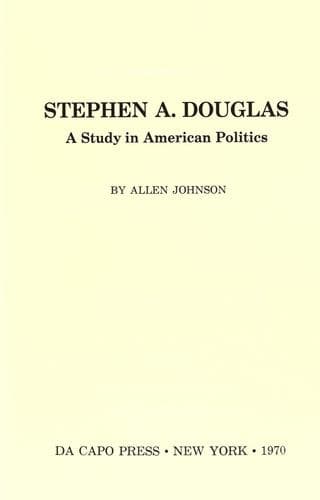
Stephen A. Douglas: A Study in American PoliticsJohnson, Allen
History
Stephen A. Douglas: A Study in American Politics
Johnson, Allen
Douglas, Stephen A. (Stephen Arnold), 1813-1861
There was, too, this vital difference between squatter sovereignty in
Utah and New Mexico and popular sovereignty in Nebraska and Kansas:
the former were at least partially inhabited and enjoyed some degree
of social and political order; the latter were practically
uninhabited. It was one thing to grant control over all domestic
concerns to a population _in esse_, and another and quite different
thing to grant control to a people _in posse_. In the Kansas-Nebraska
Act hypothetical communities were endowed with the capacity of
self-government, and told to decide for themselves a question which
would become a burning issue the very moment that the first settlers
set foot in the Territories. Congress attempted thus to solve an
equation without a single known quantity.
Moreover, slavery was no longer a matter of local concern. Doubtless
it was once so regarded; but the time had passed when the conscience
of the North would acquiesce in a _laissez faire_ policy. By force of
circumstances slavery had become a national issue. Ardent haters of
the institution were not willing that its extension or restriction
should be left to a fraction of the nation, artificially organized as
a Territory. The Kansas-Nebraska Act prejudiced the minds of many
against the doctrine, however sound in theory it may have seemed, by
unsettling what the North regarded as its vested right in the free
territory north of the line of the Missouri Compromise. The Act made
the political atmosphere electric. The conditions for obtaining a
calm, dispassionate judgment on the domestic concern of chief
interest, were altogether lacking.
It was everywhere conceded that Nebraska would be a free Territory.
The eyes of the nation were focused upon Kansas, which was from the
first debatable ground. A rush of settlers from the Northwest joined
by pioneers from Kentucky and Missouri followed the opening up of the
new lands. As Douglas had foretold, the tide of immigration held back
by Indian treaties now poured in. The characteristic features of
American colonization seemed about to repeat themselves. So far the
movement of population was for the most part spontaneous. Land-hunger,
not the political destiny of the West, drove men to locate their
claims on the Kansas and the Missouri. By midsummer colonists of a
somewhat different stripe appeared. Sent out under the auspices of the
Emigrant Aid Company, they were to win Kansas for freedom at the same
time that they subdued the wilderness. It was a species of assisted
emigration which was new in the history of American colonization,
outside the annals of missionary effort. The chief promoter of this
enterprise was a thrifty, Massachusetts Yankee, who saw no reason why
crusading and business should not go hand in hand. Kansas might be
wrested from the slave-power at the same time that returns on invested
funds were secured.
Public-domain text, read in full here on John Shaqi.
Reviews
Reviews
No reviews yet
Be the first to share your thoughts on this work.
Elsewhere in the archive
Join the Discussion
Join the discussion
Sign in to leave a comment or review.
Sign InorCreate an account