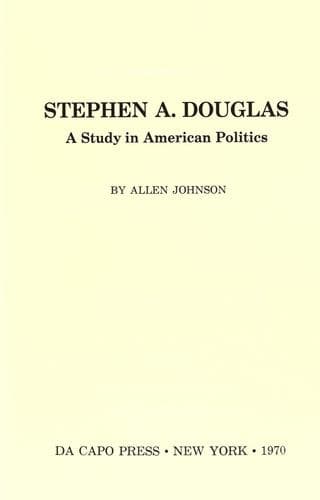
Stephen A. Douglas: A Study in American PoliticsJohnson, Allen
History
Stephen A. Douglas: A Study in American Politics
Johnson, Allen
Douglas, Stephen A. (Stephen Arnold), 1813-1861
[Footnote 583: _Ibid._, App., p. 127. Toombs also stated that the
submission clause had been put in his bill in the first place by
accident, and that it had been stricken from the bill at his
suggestion.]
[Footnote 584: The submission of State constitutions to a popular vote
had not then become a general practice.]
[Footnote 585: Rhodes, History of the United States, II, p. 195.]
[Footnote 586: _Globe_, 34 Cong., 1 Sess., App., p. 844.]
[Footnote 587: _Globe_, 35 Cong., 1 Sess., p. 21.]
[Footnote 588: Sheahan, Douglas, p. 443.]
[Footnote 589: Davidson and Stuve, History of Illinois, p. 650.]
[Footnote 590: MS. Letter, Douglas to Sheahan, October 6, 1856.]
[Footnote 591: _Tribune Almanac_, 1857. The vote was as follows:
Buchanan 105,348
Fremont 96,189
Fillmore 37,444
]
BOOK III
THE IMPENDING CRISIS
CHAPTER XIV
THE PERSONAL EQUATION
Vast changes had passed over Illinois since Douglas set foot on its
soil, a penniless boy with his fortune to make. The frontier had been
pushed back far beyond the northern boundary of the State; the Indians
had disappeared; and the great military tract had been occupied by a
thrifty, enterprising people of the same stock from which Douglas
sprang. In 1833, the center of political gravity lay far south of the
geographical center of the State; by 1856, the northern counties had
already established a political equipoise. The great city on Lake
Michigan, a lusty young giant, was yearly becoming more conscious of
its commercial and political possibilities. Douglas had natural
affinities with Chicago. It was thoroughly American, thoroughly
typical of that restless, aggressive spirit which had sent him, and
many another New Englander, into the great interior basin of the
continent. There was no other city which appealed so strongly to his
native instincts. From the first he had been impressed by its
commercial potentialities. He had staked his own fortunes upon its
invincible prosperity by investing in real estate, and within a few
years he had reaped the reward of his faith in unseen values. His
holdings both in the city and in Cook County advanced in value by
leaps and bounds, so that in the year 1856, he sold approximately one
hundred acres for $90,000. With his wonted prodigality, born of superb
confidence in future gains, he also deeded ten acres of his valuable
"Grove Property" to the trustees of Chicago University.[592] Yet with
a far keener sense of honor than many of his contemporaries exhibited,
he refused to speculate in land in the new States and Territories,
with whose political beginnings he would be associated as chairman of
the Committee on Territories. He was resolved early in his career "to
avoid public suspicion of private interest in his political
conduct."[593]
Public-domain text, read in full here on John Shaqi.
Reviews
Reviews
No reviews yet
Be the first to share your thoughts on this work.
Elsewhere in the archive
Join the Discussion
Join the discussion
Sign in to leave a comment or review.
Sign InorCreate an account