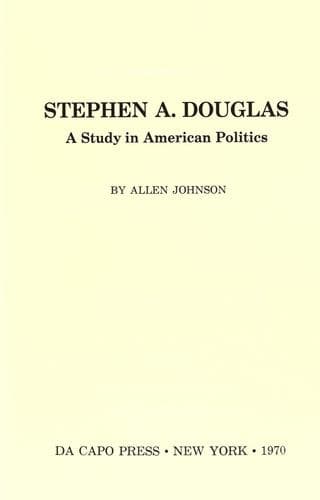
Stephen A. Douglas: A Study in American PoliticsJohnson, Allen
History
Stephen A. Douglas: A Study in American Politics
Johnson, Allen
Douglas, Stephen A. (Stephen Arnold), 1813-1861
The gift to Chicago University was no doubt inspired in part at least
by local pride; yet it was not the first nor the only instance of the
donor's interest in educational matters. No one had taken greater
interest in the bequest of James Smithson to the United States. At
first, no doubt, Douglas labored under a common misapprehension
regarding this foundation, fancying that it would contribute directly
to the advancement and diffusion of the applied sciences; but his
support was not less hearty when he grasped the policy formulated by
the first secretary of the institution. He was the author of that
provision in the act establishing the Smithsonian Institution, which
called for the presentation of one copy of every copyrighted book,
map, and musical composition, to the Institution and to the
Congressional Library.[594] He became a member of the board of regents
and retained the office until his death.
With his New England training Douglas believed profoundly in the
dignity of labor; not even his Southern associations lessened his
genuine admiration for the magnificent industrial achievements of the
Northern mechanic and craftsman. He shared, too, the conviction of his
Northern constituents, that the inventiveness, resourcefulness, and
bold initiative of the American workman was the outcome of free
institutions, which permitted and encouraged free and bold thinking.
The American laborer was not brought up to believe it "a crime to
think in opposition to the consecrated errors of olden times."[595] It
was impossible for a man so thinking to look with favor upon the
slave-labor system of the South. He might tolerate the presence of
slavery in the South; but in his heart of hearts he could not desire
its indefinite extension.
Public-domain text, read in full here on John Shaqi.
Reviews
Reviews
No reviews yet
Be the first to share your thoughts on this work.
Elsewhere in the archive
Join the Discussion
Join the discussion
Sign in to leave a comment or review.
Sign InorCreate an account