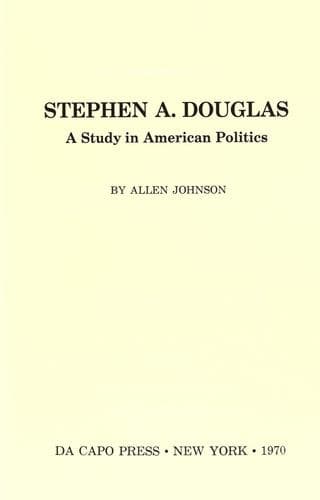
Stephen A. Douglas: A Study in American PoliticsJohnson, Allen
History
Stephen A. Douglas: A Study in American Politics
Johnson, Allen
Douglas, Stephen A. (Stephen Arnold), 1813-1861
As the representative of a constituency which was profoundly
interested in the navigation of the great interior waterways of the
continent, Douglas was a vigorous advocate of internal improvements,
so far as his Democratic conscience would allow him to construe the
Constitution in favor of such undertakings by the Federal government.
Like his constituents, he was not always logical in his deductions
from constitutional provisions. The Constitution, he believed, would
not permit an appropriation of government money for the construction
of the ship canal around the Falls of the St. Mary's; but as
landowner, the Federal government might donate lands for that
purpose.[600] He was also constrained to vote for appropriations for
the improvement of river channels and of harbors on the lakes and on
the ocean, because these were works of a distinctly national
character; but he deplored the mode by which these appropriations were
made.[601]
Just when the Nebraska issue came to the fore, he was maturing a
scheme by which a fair, consistent, and continuous policy of internal
improvements could be initiated, in place of the political bargaining
which had hitherto determined the location of government operations.
Two days before he presented his famous Nebraska report, Douglas
addressed a letter to Governor Matteson of Illinois in which he
developed this new policy.[602] He believed that the whole question
would be thoroughly aired in the session just begun.[603] Instead of
making internal improvements a matter of politics, and of wasteful
jobbery, he would take advantage of the constitutional provision
which permits a State to lay tonnage duties by the consent of
Congress. If Congress would pass a law permitting the imposition of
tonnage duties according to a uniform rule, then each town and city
might be authorized to undertake the improvement of its own harbor,
and to tax its own commerce for the prosecution of the work. Under
such a system the dangers of misuse and improper diversion of funds
would be reduced to a minimum. The system would be self-regulative.
Negligence, or extravagance, with the necessary imposition of higher
duties, would punish a port by driving shipping elsewhere.
Public-domain text, read in full here on John Shaqi.
Reviews
Reviews
No reviews yet
Be the first to share your thoughts on this work.
Elsewhere in the archive
Join the Discussion
Join the discussion
Sign in to leave a comment or review.
Sign InorCreate an account