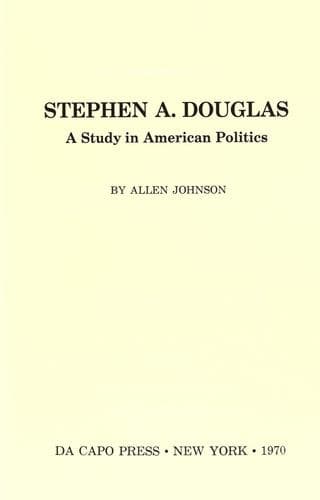
Stephen A. Douglas: A Study in American PoliticsJohnson, Allen
History
Stephen A. Douglas: A Study in American Politics
Johnson, Allen
Douglas, Stephen A. (Stephen Arnold), 1813-1861
But for the interposition of the slavery issue, which no one would
have more gladly banished from Congress, Douglas would have
unquestionably pushed some such reform into the foreground. His heart
was bound up in the material progress of the country. He could never
understand why men should allow an issue like slavery to stand in the
way of prudential and provident legislation for the expansion of the
Republic. He laid claim to no expert knowledge in other matters: he
frankly confessed his ignorance of the mysteries of tariff schedules.
"I have learned enough about the tariff," said he with a sly thrust at
his colleagues, who prided themselves on their wisdom, "to know that I
know scarcely anything about it at all; and a man makes considerable
progress on a question of this kind when he ascertains that
fact."[604] Still, he grasped an elementary principle that had escaped
many a protectionist, that "a tariff involves two conflicting
principles which are eternally at war with each other. Every tariff
involves the principles of protection and of oppression, the
principles of benefits and of burdens.... The great difficulty is, so
to adjust these conflicting principles of benefits and burdens as to
make one compensate for the other in the end, and give equal benefits
and equal burdens to every class of the community."[605]
Douglas was wiser, too, than the children of light, when he insisted
that works of art should be admitted free of duty. "I wish we could
get a model of every work of art, a cast of every piece of ancient
statuary, a copy of every valuable painting and rare book, so that our
artists might pursue their studies and exercise their skill at home,
and that our literary men might not be exiled in the pursuits which
bless mankind."[606]
Still, the prime interests of this hardy son of the West were
political. How could they have been otherwise in his environment?
There is no evidence of literary refinement in his public utterances;
no trace of the culture which comes from intimate association with the
classics; no suggestion of inspiration quaffed in communion with
imaginative and poetic souls. An amusing recognition of these
limitations is vouched for by a friend, who erased a line of poetry
from a manuscript copy of a public address by Douglas. Taken to task
for his presumption, he defended himself by the indisputable
assertion, that Douglas was never known to have quoted a line of
poetry in his life.[607] Yet the unimaginative Douglas anticipated the
era of aerial navigation now just dawning. On one occasion, he urged
upon the Senate a memorial from an aeronaut, who desired the aid of
the government in experiments which he was conducting with dirigible
balloons. When the Senate, in a mirthful mood, proposed to refer the
petition to the Committee on Foreign Affairs, Douglas protested that
the subject should be treated seriously.[608]
Public-domain text, read in full here on John Shaqi.
Reviews
Reviews
No reviews yet
Be the first to share your thoughts on this work.
Elsewhere in the archive
Join the Discussion
Join the discussion
Sign in to leave a comment or review.
Sign InorCreate an account