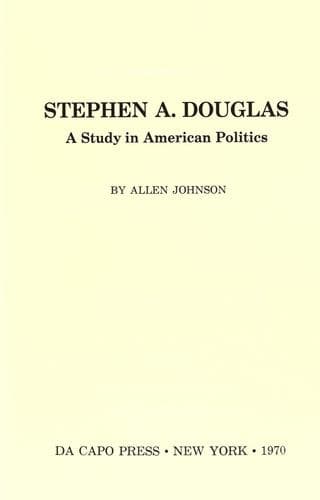
Stephen A. Douglas: A Study in American PoliticsJohnson, Allen
History
Stephen A. Douglas: A Study in American Politics
Johnson, Allen
Douglas, Stephen A. (Stephen Arnold), 1813-1861
No one could gainsay his leadership. He was indisputably the most
influential man in his party; and this leadership was not bought by
obsequiousness to party opinion, nor by the shadowy arts of the
machine politician alone. True, he was a spoilsman, like all of his
contemporaries. He was not above using the spoils of office to reward
faithful followers. Reprehensible as the system was, and is, there is
perhaps a redeeming feature in this aspect of American politics. The
ignorant foreigner was reconciled to government because it was made to
appear to him as a personal benefactor. Due credit must be given to
those leaders like Douglas, who fired the hearts of Irishmen and
Germans with loyalty to the Union through the medium of party.[615]
The hold of Douglas upon his following, however, cannot be explained
by sordid appeals to their self-interest. He commanded the unbought
service of thousands. In the early days of his career, he had found
loyal friends, who labored unremittingly for his advancement, without
hope of pecuniary reward or of any return but personal gratitude; and
throughout his career he drew upon this vast fund of personal loyalty.
His capacity for warm friendships was unlimited. He made men,
particularly young men, feel that it was an inestimable boon to be
permitted to labor with him "for the cause." Far away in Asia Minor,
with his mind teeming with a thousand strange sensations, he can yet
think of a friend at the antipodes who nurses a grievance against him;
and forthwith he sits down and writes five pages of generous,
affectionate remonstrance.[616] In the thick of an important campaign,
when countless demands are made upon his time, he finds a moment to
lay his hand upon the shoulder of a young German ward-politician with
the hearty word, "I count very much on your help in this
election."[617] If this was the art of a politician, it was art
reduced to artlessness.
Not least among the qualities which made Douglas a great, persuasive,
popular leader, was his quite extraordinary memory for names and
faces, and his unaffected interest in the personal life of those whom
he called his friends. "He gave to every one of those humble and
practically nameless followers the impression, the feeling, that he
was the frank, personal friend of each one of them."[618] Doubtless he
was well aware that there is no subtler form of flattery, than to call
individuals by name who believe themselves to be forgotten pawns in a
great game; and he may well have cultivated the profitable habit.
Still, the fact remains, that it was an innate temperamental quality
which made him frank and ingenuous in his intercourse with all sorts
and conditions of men.
Public-domain text, read in full here on John Shaqi.
Reviews
Reviews
No reviews yet
Be the first to share your thoughts on this work.
Elsewhere in the archive
Join the Discussion
Join the discussion
Sign in to leave a comment or review.
Sign InorCreate an account