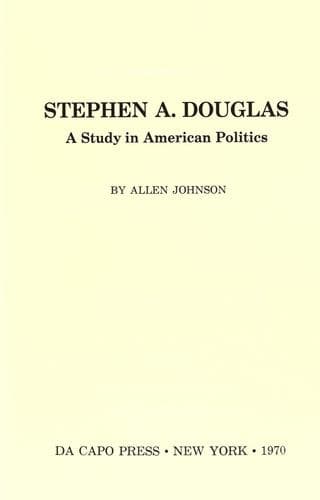
Stephen A. Douglas: A Study in American PoliticsJohnson, Allen
History
Stephen A. Douglas: A Study in American Politics
Johnson, Allen
Douglas, Stephen A. (Stephen Arnold), 1813-1861
The inauguration of James Buchanan and the Dred Scott decision of the
Supreme Court, two days later, marked a turning point in the career of
Judge Douglas. Of this he was of course unaware. He accepted the
advent of his successful rival with composure, and the opinion of the
Court, with comparative indifference. In a speech before the Grand
Jury of the United States District Court at Springfield, three months
later, he referred publicly for the first time to the Dred Scott case.
Senator, and not Judge, Douglas was much in evidence. He swallowed the
opinion of the majority of the court without wincing--the _obiter
dictum_ and all. Nay, more, he praised the Court for passing, like
honest and conscientious judges, from the technicalities of the case
to the real merits of the questions involved. The material,
controlling points of the case were: first, that a negro descended
from slave parents could not be a citizen of the United States;
second, that the Missouri Compromise was unconstitutional and void
from the beginning, and thus could not extinguish a master's right to
his slave in any Territory. "While the right continues in full force
under ... the Constitution," he added, "and cannot be divested or
alienated by an act of Congress, it necessarily remains a barren and
worthless right, unless sustained, protected, and enforced by
appropriate police regulations and local legislation, prescribing
adequate remedies for its violation. These regulations and remedies
must necessarily depend entirely upon the will and wishes of the
people of the Territory, as they can only be prescribed by the local
legislatures." Hence the triumphant conclusion that "the great
principle of popular sovereignty and self-government is sustained and
firmly established by the authority of this decision."[620]
There were acute legal minds who thought that they detected a false
note in this paean. Was this a necessary implication from the Dred
Scott decision? Was it the intention of the Court to leave the
principle of popular sovereignty standing upright? Was not the
decision rather fatal to the great doctrine--the shibboleth of the
Democratic party?
On this occasion Douglas had nothing to add to his exposition of the
Dred Scott case, further than to point out the happy escape of white
supremacy from African equality. And here he struck the note which put
him out of accord with those Northern constituents with whom he was
otherwise in complete harmony. "When you confer upon the African race
the privileges of citizenship, and put them on an equality with white
men at the polls, in the jury box, on the bench, in the Executive
chair, and in the councils of the nation, upon what principle will you
deny their equality at the festive board and in the domestic circle?"
In the following year, he received his answer in the homely words of
Abraham Lincoln: "I do not understand that because I do not want a
negro woman for a slave I must necessarily want her for a wife."
Public-domain text, read in full here on John Shaqi.
Reviews
Reviews
No reviews yet
Be the first to share your thoughts on this work.
Elsewhere in the archive
Join the Discussion
Join the discussion
Sign in to leave a comment or review.
Sign InorCreate an account