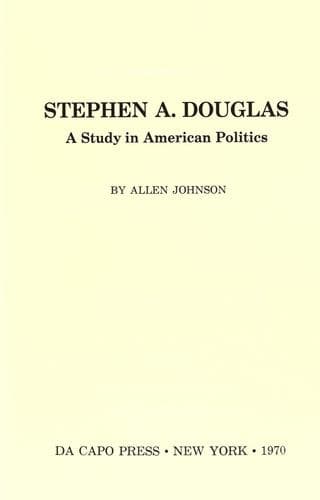
Stephen A. Douglas: A Study in American PoliticsJohnson, Allen
History
Stephen A. Douglas: A Study in American Politics
Johnson, Allen
Douglas, Stephen A. (Stephen Arnold), 1813-1861
Had anyone prophesied at the close of the year 1856, that within a
twelvemonth Douglas would be denounced as a traitor to Democracy, he
would have been thought mad. That Douglas of all men should break with
his party under any circumstances was almost unthinkable. His whole
public career had been inseparably connected with his party. To be
sure, he had never gone so far as to say "my party right or wrong";
but that was because he had never felt obliged to make a moral choice.
He was always convinced that his party was right. Within the
circumference of party, he had always found ample freedom of movement.
He had never lacked the courage of his convictions, but hitherto his
convictions had never collided with the dominant opinion of Democracy.
He undoubtedly believed profoundly in the mission of his party, as an
organization standing above all for popular government and the
preservation of the Union. No ordinary circumstances would justify him
in weakening the influence or impairing the organization of the
Democratic party. Paradoxical as it may seem, his partisanship was
dictated by a profound patriotism. He believed the maintenance of the
Union to be dependent upon the integrity of his party. So thinking and
feeling he entered upon the most memorable controversy of his career.
When President Buchanan asked Robert J. Walker of Mississippi to
become governor of Kansas, the choice met with the hearty approval of
Douglas. Not all the President's appointments had been acceptable to
the Senator from Illinois. But here was one that he could indorse
unreservedly. He used all his influence to persuade Walker to accept
the uncoveted mission. With great reluctance Walker consented, but
only upon the most explicit understanding with the administration as
to the policy to be followed in Kansas. It was well understood on both
sides that a true construction of the Kansas-Nebraska Act required the
submission to popular vote of any constitution which the prospective
convention might adopt. This was emphatically the view of Douglas,
whom Governor Walker took pains to consult on his way through
Chicago.[621]
Public-domain text, read in full here on John Shaqi.
Reviews
Reviews
No reviews yet
Be the first to share your thoughts on this work.
Elsewhere in the archive
Join the Discussion
Join the discussion
Sign in to leave a comment or review.
Sign InorCreate an account