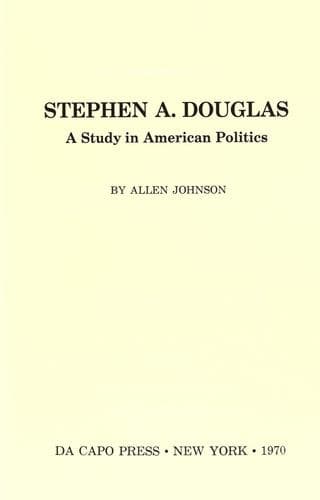
Stephen A. Douglas: A Study in American PoliticsJohnson, Allen
History
Stephen A. Douglas: A Study in American Politics
Johnson, Allen
Douglas, Stephen A. (Stephen Arnold), 1813-1861
The call for an election of delegates to a constitutional convention
had already been issued, when Walker reached Kansas. The free-State
people were incensed because the appointment of delegates had been
made on the basis of a defective census and registration; and even the
assurance of the governor, in his inaugural, that the constitution
would be submitted to a popular vote, failed to overcome their
distrust. They therefore took no part in the election of delegates.
This course was unfortunate, for it gave the control of the convention
wholly into the hands of the pro-slavery party, with consequences that
were far-reaching for Kansas and the nation.[622] But by October the
free-State party had abandoned its policy of abstention from
territorial politics, so far as to participate in the election of a
new territorial legislature. The result was a decisive free-State
victory. The next legislature would have an ample majority of
free-State men in both chambers. It was with the discomfiting
knowledge, then, that they represented only a minority of the
community that the delegates of the constitutional convention began
their labors.[623] It was clear to the dullest intelligence that any
pro-slavery constitution would be voted down, if it were submitted
fairly to the people of Kansas. Gloom settled down upon the hopes of
the pro-slavery party.
When the document which embodied the labors of the convention was made
public, the free-State party awoke from its late complacence to find
itself tricked by a desperate game. The constitution was not to be
submitted to a full and fair vote; but only the article relating to
slavery. The people of Kansas were to vote for the "Constitution with
slavery" or for the "Constitution with no slavery." By either
alternative the constitution would be adopted. But should the
constitution with no slavery be ratified, a clause of the schedule
still guaranteed "the right of property in slaves now in this
Territory."[624] The choice offered to an opponent of slavery in
Kansas was between a constitution sanctioning and safeguarding all
forms of slave property,[625] and a constitution which guaranteed the
full possession of slaves then in the Territory, with no assurances
as to the status of the natural increase of these slaves. Viewed in
the most charitable light, this was a gambler's device for securing
the stakes by hook or crook. Still further to guard existing property
rights in slaves, it was provided that if the constitution should be
amended after 1864, no alteration should be made to affect "the rights
of property in the ownership of slaves."[626]
Public-domain text, read in full here on John Shaqi.
Reviews
Reviews
No reviews yet
Be the first to share your thoughts on this work.
Elsewhere in the archive
Join the Discussion
Join the discussion
Sign in to leave a comment or review.
Sign InorCreate an account