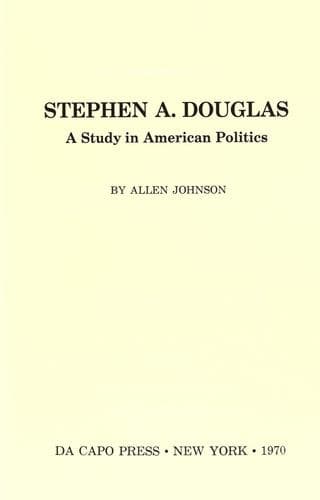
Stephen A. Douglas: A Study in American PoliticsJohnson, Allen
History
Stephen A. Douglas: A Study in American Politics
Johnson, Allen
Douglas, Stephen A. (Stephen Arnold), 1813-1861
Douglas found himself subjected to a new pressure, harder even to
resist than any he had yet felt. Some of his staunch supporters in the
anti-Lecompton struggle went over to the administration, covering
their retreat by just such excuses as have been suggested. Was he
wiser and more conscientious than they? A refusal to accept the
proffered olive branch now meant,--he knew it well,--the
irreconcilable enmity of the Buchanan faction. And he was not asked to
recant, but only to accept what he had always deemed the very essence
of statesmanship, a compromise. His Republican allies promptly evinced
their distrust. They fully expected him to join his former associates.
From them he could expect no sympathy in such a dilemma.[662] His
political ambitions, no doubt, added to his perplexity. They were
bound up in the fate of the party, the integrity of which was now
menaced by his revolt. On the other hand, he was fully conscious that
his Illinois constituency approved of his opposition to Lecomptonism
and would regard a retreat across this improvised political bridge as
both inglorious and treacherous. Agitated by conflicting emotions,
Douglas made a decision which probably cost him more anguish than any
he ever made; and when all has been said to the contrary, love of fair
play would seem to have been his governing motive.[663]
When Douglas rose to address the Senate on the English bill, April
29th, he betrayed some of the emotion under which he had made his
decision. He confessed an "anxious desire" to find such provisions as
would permit him to support the bill; but he was painfully forced to
declare that he could not find the principle for which he had
contended, fairly carried out. He was unable to reconcile popular
sovereignty with the proposed intervention of Congress in the English
bill. "It is intervention with inducements to control the result. It
is intervention with a bounty on the one side and a penalty on the
other."[664] He frankly admitted that he did not believe there was
enough in the bounty nor enough in the penalty to influence materially
the vote of the people of Kansas; but it involved "the principle of
freedom of election and--the great principle of self-government upon
which our institutions rest." And upon this principle he took his
stand. "With all the anxiety that I have had," said he with deep
feeling, "to be able to arrive at a conclusion in harmony with the
overwhelming majority of my political friends in Congress, I could not
bring my judgment or conscience to the conclusion that this was a
fair, impartial, and equal application of the principle."[665]
Public-domain text, read in full here on John Shaqi.
Reviews
Reviews
No reviews yet
Be the first to share your thoughts on this work.
Elsewhere in the archive
Join the Discussion
Join the discussion
Sign in to leave a comment or review.
Sign InorCreate an account