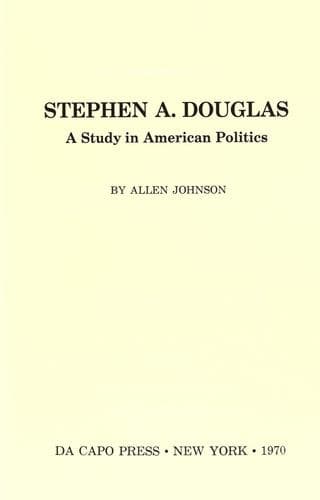
Stephen A. Douglas: A Study in American PoliticsJohnson, Allen
History
Stephen A. Douglas: A Study in American Politics
Johnson, Allen
Douglas, Stephen A. (Stephen Arnold), 1813-1861
No general ever planned a military campaign with greater regard to the
topography of the enemy's country, than Douglas plotted his campaign
in central Illinois. For it was in the central counties that the
election was to be won or lost. The Republican strength lay in the
upper, northern third of the State; the Democratic strength, in the
southern third. The doubtful area lay between Ottawa on the north and
Belleville on the south; Oquawka on the northwest and Paris on the
east. Only twice did Douglas make any extended tour outside this area:
once to meet his appointment with Lincoln at Freeport; and once to
engage in the third joint debate at Jonesboro.
The first week in August found Douglas speaking at various points
along the Illinois River to enthusiastic crowds. Lincoln followed
closely after, bent upon weakening the force of his opponent's
arguments by lodging an immediate demurrer against them. On the whole,
Douglas drew the larger crowds; but it was observed that Lincoln's
audiences increased as he proceeded northward. Ottawa was the
objective point for both travelers, for there was to be held the first
joint debate on August 21st.
An enormous crowd awaited them. From sunrise to mid-day men, women,
and children had poured into town, in every sort of conveyance. It was
a typical midsummer day in Illinois. The prairie roads were thoroughly
baked by the sun, and the dust rose, like a fine powder, from beneath
the feet of horses and pedestrians, enveloping all in blinding clouds.
A train of seventeen cars had brought ardent supporters of Douglas
from Chicago. The town was gaily decked; the booming of cannon
resounded across the prairie; bands of music added to the excitement
of the occasion. The speakers were escorted to the public square by
two huge processions. So eager was the crowd that it was with much
difficulty, and no little delay, that Lincoln and Douglas, the
committee men, and the reporters, were landed on the platform.[708]
For the first time in the campaign, the rival candidates were placed
side by side. The crowd instinctively took its measure of the two men.
They presented a striking contrast:[709] Lincoln, tall, angular, and
long of limb; Douglas, short, almost dwarfed by comparison,
broad-shouldered and thick-chested. Lincoln was clad in a frock coat
of rusty black, which was evidently not made for his lank, ungainly
body. His sleeves did not reach his wrists by several inches, and his
trousers failed to conceal his huge feet. His long, sinewy neck
emerged from a white collar, drawn over a black tie. Altogether, his
appearance bordered upon the grotesque, and would have provoked mirth
in any other than an Illinois audience, which knew and respected the
man too well to mark his costume. Douglas, on the contrary, presented
a well-groomed figure. He wore a well-fitting suit of broadcloth; his
linen was immaculate; and altogether he had the appearance of a man of
the world whom fortune had favored.
Public-domain text, read in full here on John Shaqi.
Reviews
Reviews
No reviews yet
Be the first to share your thoughts on this work.
Elsewhere in the archive
Join the Discussion
Join the discussion
Sign in to leave a comment or review.
Sign InorCreate an account