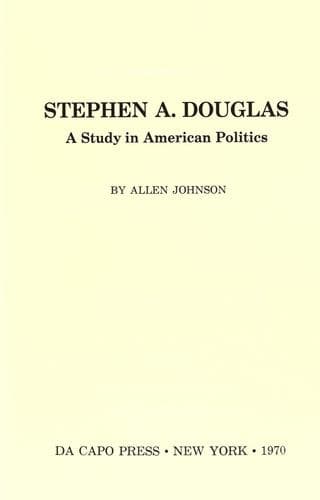
Stephen A. Douglas: A Study in American PoliticsJohnson, Allen
History
Stephen A. Douglas: A Study in American Politics
Johnson, Allen
Douglas, Stephen A. (Stephen Arnold), 1813-1861
The eyes of the crowd, however, sought rather the faces of the rival
candidates. Lincoln looked down upon them with eyes in which there was
an expression of sadness, not to say melancholy, until he lost himself
in the passion of his utterance. There was not a regular feature in
his face. The deep furrows that seamed his countenance bore
unmistakable witness to a boyhood of grim poverty and grinding toil.
Douglas surveyed the crowd from beneath his shaggy brows, with bold,
penetrating gaze. Every feature of his face bespoke power. The
deep-set eyes; the dark, almost sinister, line between them; the mouth
with its tightly-drawn lips; the deep lines on his somewhat puffy
cheeks--all gave the impression of a masterful nature, accustomed to
bear down opposition. As men observed his massive brow with its mane
of abundant, dark hair; his strong neck; his short, compact body; they
instinctively felt that here was a personality not lightly to be
encountered. He was "the very embodiment of force, combativeness, and
staying power."[710]
When Douglas, by agreement, opened the debate, he was fully conscious
that he was addressing an audience which was in the main hostile to
him. With the instinct of a born stump speaker, he sought first to
find common ground with his hearers. Appealing to the history of
parties, he pointed out the practical agreement of both Whig and
Democratic parties on the slavery question down to 1854. It was when,
in accordance with the Compromise of 1850, he brought in the
Kansas-Nebraska bill, that Lincoln and Trumbull entered into an
agreement to dissolve the old parties in Illinois and to form an
Abolition party under the pseudonym "Republican." The terms of the
alliance were that Lincoln should have Senator Shields' place in the
Senate, and that Trumbull should have Douglas's, when his term should
expire.[711] History, thus interpreted, made not Douglas, but his
opponent, the real agitator in State politics.
Public-domain text, read in full here on John Shaqi.
Reviews
Reviews
No reviews yet
Be the first to share your thoughts on this work.
Elsewhere in the archive
Join the Discussion
Join the discussion
Sign in to leave a comment or review.
Sign InorCreate an account