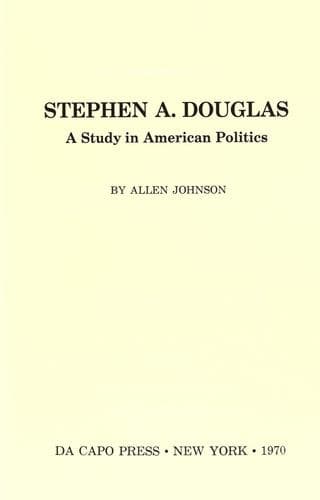
Stephen A. Douglas: A Study in American PoliticsJohnson, Allen
History
Stephen A. Douglas: A Study in American Politics
Johnson, Allen
Douglas, Stephen A. (Stephen Arnold), 1813-1861
Douglas then read from the first platform of the Black Republicans.
"My object in reading these resolutions," he said, "was to put the
question to Abraham Lincoln this day, whether he now stands and will
stand by each article in that creed and carry it out. I desire to know
whether Mr. Lincoln to-day stands, as he did in 1854, in favor of the
unconditional repeal of the Fugitive Slave law. I desire him to answer
whether he stands pledged to-day, as he did in 1854, against the
admission of any more slave States into the Union, even if the people
want them. I want to know whether he stands pledged against the
admission of a new State into the Union with such a Constitution as
the people of that State may see fit to make. I want to know whether
he stands to-day pledged to the abolition of slavery in the District
of Columbia. I desire him to answer whether he stands pledged to the
prohibition of the slave trade between the different States. I desire
to know whether he stands pledged to prohibit slavery in all the
Territories of the United States, North as well as South of the
Missouri Compromise line. I desire him to answer whether he is opposed
to the acquisition of any more territory, unless slavery is prohibited
therein."[712]
In all this there was a rude vehemence and coarse insinuation that was
regrettable; yet Douglas sought to soften the asperity of his manner,
by adding that he did not mean to be disrespectful or unkind to Mr.
Lincoln. He had known Mr. Lincoln for twenty-five years. While he was
a school-teacher, Lincoln was a flourishing grocery-keeper. Lincoln
was always more successful in business; Lincoln always did well
whatever he undertook; Lincoln could beat any of the boys wrestling or
running a foot-race; Lincoln could ruin more liquor than all the boys
of the town together. When in Congress, Lincoln had distinguished
himself by his opposition to the Mexican War, taking the side of the
enemy against his own country.[713] If this disparagement of an
opponent seems mean and ungenerous, let it be remembered that in the
rough give-and-take of Illinois politics, hard hitting was to be
expected. Lincoln had invited counter-blows by first charging Douglas
with conspiracy. No mere reading of cold print can convey the virile
energy with which Douglas spoke. The facial expression, the animated
gesture, the toss of the head, and the stamp of the foot, the full,
resonant voice--all are wanting.
Public-domain text, read in full here on John Shaqi.
Reviews
Reviews
No reviews yet
Be the first to share your thoughts on this work.
Elsewhere in the archive
Join the Discussion
Join the discussion
Sign in to leave a comment or review.
Sign InorCreate an account