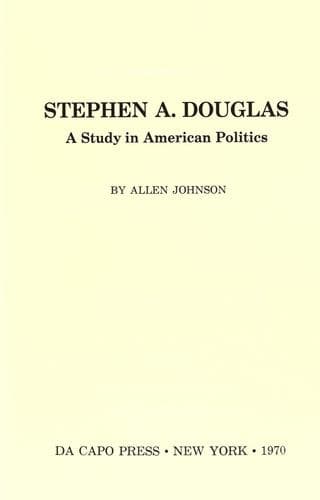
Stephen A. Douglas: A Study in American PoliticsJohnson, Allen
History
Stephen A. Douglas: A Study in American Politics
Johnson, Allen
Douglas, Stephen A. (Stephen Arnold), 1813-1861
When the contestants met at Freeport, far in the solid Republican
counties of the North, Lincoln was ready with his answers to the
questions propounded by Douglas at Ottawa. In most respects Lincoln
was clear and explicit. While not giving an unqualified approval of
the Fugitive Slave Law, he was not in favor of its repeal; while
believing that Congress possessed the power to abolish slavery in the
District of Columbia, he favored abolition only on condition that it
should be gradual, acceptable to a majority of the voters of the
District, and compensatory to unwilling owners; he would favor the
abolition of the slave-trade between the States only upon similar
conservative principles; he believed it, however, to be the right and
duty of Congress to prohibit slavery in all the Territories; he was
not opposed to the honest acquisition of territory, provided that it
would not aggravate the slavery question. The really crucial
questions, Lincoln did not face so unequivocally. Was he opposed to
the admission of more slave States? Would he oppose the admission of a
new State with such a constitution as the people of that State should
see fit to make?
Lincoln answered hesitatingly: "In regard to the other question, of
whether I am pledged to the admission of any more slave States into
the Union, I state to you very frankly that I would be exceedingly
sorry ever to be put in a position of having to pass upon that
question. I should be exceedingly glad to know that there would never
be another slave State admitted into the Union; but I must add, that
if slavery shall be kept out of the Territories during the territorial
existence of any one given Territory, and then the people shall,
having a fair chance and a clear field, when they come to adopt the
Constitution, do such an extraordinary thing as to adopt a slave
Constitution, uninfluenced by the actual presence of the institution
among them, I see no alternative, if we own the country, but to admit
them into the Union."[723]
It was now Lincoln's turn to catechise his opponent. He had prepared
four questions, the second of which caused his friends some
misgivings.[724] It read: "Can the people of a United States
Territory, in any lawful way, against the wish of any citizen of the
United States, exclude slavery from its limits prior to the formation
of a State Constitution?"
Public-domain text, read in full here on John Shaqi.
Reviews
Reviews
No reviews yet
Be the first to share your thoughts on this work.
Elsewhere in the archive
Join the Discussion
Join the discussion
Sign in to leave a comment or review.
Sign InorCreate an account