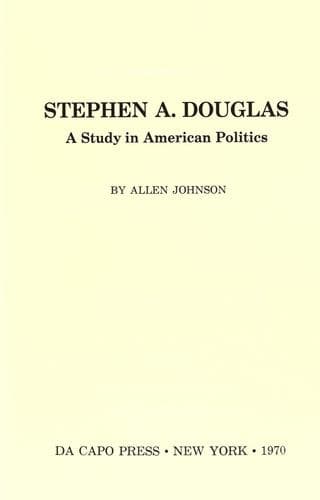
Stephen A. Douglas: A Study in American PoliticsJohnson, Allen
History
Stephen A. Douglas: A Study in American Politics
Johnson, Allen
Douglas, Stephen A. (Stephen Arnold), 1813-1861
The next joint debate occurred nearly three weeks later down in Egypt.
By slow stages, speaking incessantly at all sorts of meetings, Douglas
and Lincoln made their several ways through the doubtful central
counties to Jonesboro in Union County. This was the enemy's country
for Lincoln; and by reason of the activities of United States Marshal
Dougherty, a Buchanan appointee, the county was scarcely less hostile
to Douglas. The meeting was poorly attended. Those who listened to the
speakers were chary of applause and appeared politically
apathetic.[731]
Douglas opened the debate by a wild, unguarded appeal to partisan
prejudices. Knowing his hearers, he was personally vindictive in his
references to Black Republicans in general and to Lincoln in
particular. He reiterated his stock arguments, giving new vehemence to
his charge of corrupt bargain between Trumbull and Lincoln by quoting
Matheny, a Republican and "Mr. Lincoln's especial and confidential
friend for the last twenty years."[732]
Lincoln begged leave to doubt the authenticity of this new evidence,
in view of the little episode at Ottawa, concerning the Springfield
resolutions. At all events the whole story was untrue, and he had
already declared it to be such.[733] Why should Douglas persist in
misrepresenting him? Brushing aside these lesser matters, however,
Lincoln addressed himself to what had now come to be known as
Douglas's Freeport doctrine. "I hold," said he, "that the proposition
that slavery cannot enter a new country without police regulations is
historically false.... There is enough vigor in slavery to plant
itself in a new country even against unfriendly legislation. It takes
not only law but the enforcement of law to keep it out." Moreover, the
decision of the Supreme Court in the Dred Scott case had created
constitutional obligations. Now that the right of property in slaves
was affirmed by the Constitution, according to the Court, how could a
member of a territorial legislature, who had taken the oath to
support the Constitution, refuse to give his vote for laws necessary
to establish slave property? And how could a member of Congress keep
his oath and withhold the necessary protection to slave property in
the Territories?[734]
Of course Lincoln was well aware that Douglas held that the Court had
decided only the question of jurisdiction in the Dred Scott case; and
that all else was a mere _obiter dictum_. Nevertheless, "the Court did
pass its opinion.... If they did not decide, they showed what they
were ready to decide whenever the matter was before them. They used
language to this effect: That inasmuch as Congress itself could not
exercise such a power [_i.e._, pass a law prohibiting slavery in the
Territories], it followed as a matter of course that it could not
authorize a Territorial Government to exercise it; for the Territorial
Legislature can do no more than Congress could do."[735]
Public-domain text, read in full here on John Shaqi.
Reviews
Reviews
No reviews yet
Be the first to share your thoughts on this work.
Elsewhere in the archive
Join the Discussion
Join the discussion
Sign in to leave a comment or review.
Sign InorCreate an account