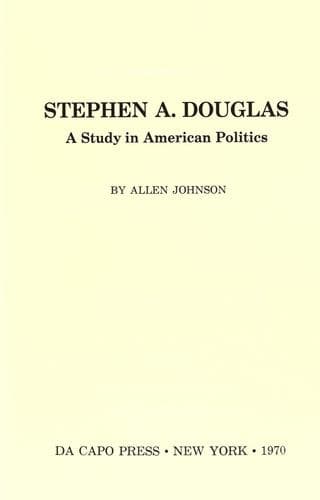
Stephen A. Douglas: A Study in American PoliticsJohnson, Allen
History
Stephen A. Douglas: A Study in American Politics
Johnson, Allen
Douglas, Stephen A. (Stephen Arnold), 1813-1861
Smarting under Lincoln's animadversions respecting the Springfield
resolutions, Douglas explained his error by quoting from a copy of the
Illinois _State Register_, which had printed the resolutions as the
work of the convention at the capital. He gave notice that he would
investigate the matter, "when he got down to Springfield." At all
events there was ample proof that the resolutions were a faithful
exposition of Republican doctrine in the year 1854. Douglas then read
similar resolutions adopted by a convention in Rockford County. One
Turner, who was acting as one of the moderators, interrupted him at
this point, to say that he had drawn those very resolutions and that
they were the Republican creed exactly. "And yet," exclaimed Douglas
triumphantly, "and yet Lincoln denies that he stands on them. Mr.
Turner says that the creed of the Black Republican party is the
admission of no more slave States, and yet Mr. Lincoln declares that
he would not like to be placed in a position where he would have to
vote for them. All I have to say to friend Lincoln is, that I do not
think there is much danger of his being placed in such a position....
I propose, out of mere kindness, to relieve him from any such
necessity."[728]
As he continued, Douglas grew offensively denunciatory. His opponents
were invariably Black Republicans; Lincoln was the ally of rank
Abolitionists like Giddings and Fred Douglass; of course those who
believed in political and social equality for blacks and whites would
vote for Lincoln. Lincoln had found fault with the resolutions because
they were not adopted on the right spot. Lincoln and his friends were
great on "spots." Lincoln had opposed the Mexican War because
American blood was not shed on American soil in the right spot.
Trumbull and Lincoln were like two decoy ducks which lead the flock
astray. Ambition, personal ambition, had led to the formation of the
Black Republican party. Lincoln and his friends were now only trying
to secure what Trumbull had cheated them out of in 1855, when the
senatorship fell to Trumbull. Under this savage attack the crowd grew
restive. As Douglas repeated the epithet "Black" Republican, he was
interrupted by indignant cries of "White," "White." But Douglas
shouted back defiantly, "I wish to remind you that while Mr. Lincoln
was speaking there was not a Democrat vulgar and blackguard enough to
interrupt him," and browbeat his hearers into quiet again.[729]
Realizing, perhaps, the immense difficulty of exposing the fallacy of
Douglas's reply to his questions, in the few moments at his disposal,
Lincoln did not refer to the crucial point. He contented himself with
a defense of his own consistency. His best friends were dispirited,
when the half-hour ended. They could not shake off the impression that
Douglas had saved himself from defeat by his adroit answers to
Lincoln's interrogatories.[730]
Public-domain text, read in full here on John Shaqi.
Reviews
Reviews
No reviews yet
Be the first to share your thoughts on this work.
Elsewhere in the archive
Join the Discussion
Join the discussion
Sign in to leave a comment or review.
Sign InorCreate an account