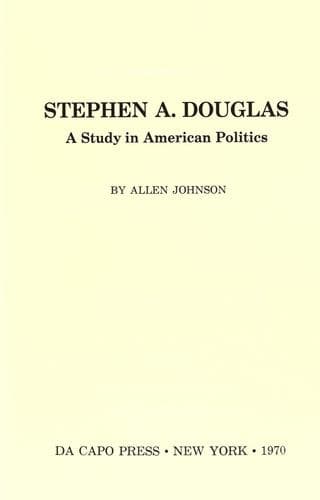
Stephen A. Douglas: A Study in American PoliticsJohnson, Allen
History
Stephen A. Douglas: A Study in American Politics
Johnson, Allen
Douglas, Stephen A. (Stephen Arnold), 1813-1861
When the rivals met three weeks later at Galesburg, they were disposed
to drop personalities. Indeed, both were aware that they were about to
address men and women who demanded an intelligent discussion of the
issues of the hour. Lincoln had the more sympathetic hearing, for Knox
County was consistently Republican; and the town with its academic
atmosphere and New England traditions shared his hostility to slavery.
Vast crowds braved the cold, raw winds of the October day to listen
for three hours to this debate.[754] From a platform on the college
campus, Douglas looked down somewhat defiantly upon his hearers,
though his words were well-chosen and courteous. The circumstances
were much the same as at Ottawa; and he spoke in much the same vein.
He rang the changes upon his great fundamental principle; he defended
his course in respect to Lecomptonism; he denounced the Republican
party as a sectional organization whose leaders were bent upon
"outvoting, conquering, governing, and controlling the South."
Douglas laid great stress upon this sectional aspect of Republicanism,
which made its southward extension impossible. "Not only is this
Republican party unable to proclaim its principles alike in the North
and in the South, in the free States and in the slave States, but it
cannot even proclaim them in the same forms and give them the same
strength and meaning in all parts of the same State. My friend Lincoln
finds it extremely difficult to manage a debate in the center part of
the State, where there is a mixture of men from the North and the
South."[755]
Here Douglas paused to read from Lincoln's speeches at Chicago and at
Charleston, and to ask his hearers to reconcile the conflicting
statements respecting negro equality. He pronounced Lincoln's
doctrine, that the negro and the white man are made equal by the
Declaration of Independence and Divine Providence, "a monstrous
heresy."
Lincoln protested that nothing was farther from his purpose than to
"advance hypocritical and deceptive and contrary views in different
portions of the country." As for the charge of sectionalism, Judge
Douglas was himself fast becoming sectional, for his speeches no
longer passed current south of the Ohio as they had once done.
"Whatever may be the result of this ephemeral contest between Judge
Douglas and myself, I see the day rapidly approaching when his pill of
sectionalism, which he has been thrusting down the throats of
Republicans for years past, will be crowded down his own throat."[756]
Public-domain text, read in full here on John Shaqi.
Reviews
Reviews
No reviews yet
Be the first to share your thoughts on this work.
Elsewhere in the archive
Join the Discussion
Join the discussion
Sign in to leave a comment or review.
Sign InorCreate an account