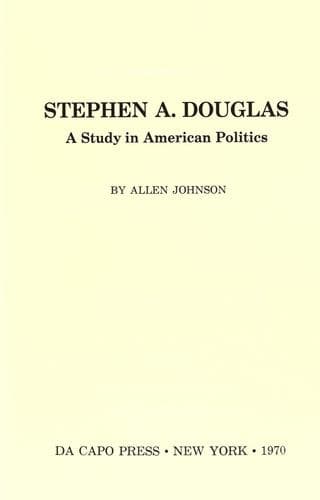
Stephen A. Douglas: A Study in American PoliticsJohnson, Allen
History
Stephen A. Douglas: A Study in American Politics
Johnson, Allen
Douglas, Stephen A. (Stephen Arnold), 1813-1861
And Lincoln again scored on his opponent, when he pointed out that
his political doctrine rested upon the major premise, that there was
no wrong in slavery. "If you will take the Judge's speeches, and
select the short and pointed sentences expressed by him,--as his
declaration that he 'don't care whether slavery is voted up or
down'--you will see at once that this is perfectly logical, if you do
not admit that slavery is wrong.... Judge Douglas declares that if any
community wants slavery they have a right to have it. He can say that
logically, if he says that there is no wrong in slavery; but if you
admit that there is a wrong in it, he cannot logically say that
anybody has a right to do wrong."[757]
Those who now read these memorable debates dis-passionately, will
surely acquit Lincoln of inconsistency in his attitude toward the
negro. His speech at Charleston supplements the speech at Chicago; at
Galesburg, he made an admirable re-statement of his position.
Nevertheless, there was a marked difference in point of emphasis
between his utterances in Northern and in Southern Illinois. Even the
casual reader will detect subtle omissions which the varying character
of his audience forced upon Lincoln. In Chicago he said nothing about
the physical inferiority of the negro; he said nothing about the
equality of the races in the Declaration of Independence, when he
spoke at Charleston. Among men of anti-slavery leanings, he had much
to say about the moral wrong of slavery; in the doubtful counties,
Lincoln was solicitous that he should not be understood as favoring
social and political equality between whites and blacks.
Feeling keenly this diplomatic shifting of emphasis, Douglas persisted
in accusing Lincoln of inconsistency: "He has one set of principles
for the Abolition counties and another set for the counties opposed to
Abolitionism." If Lincoln had said in Coles County what he has to-day
said in old Knox, Douglas complained, "it would have settled the
question between us in that doubtful county."[758] And in this Douglas
was probably correct.
At Quincy, Douglas was in his old bailiwick. Three times the Democrats
of this district had sent him to Congress; and though the bounds of
the congressional district had since been changed, Adams County was
still Democratic by a safe majority. Among the people who greeted the
speakers, however, were many old-time Whigs, for whose special benefit
the Republicans of the city carried on a pole, at the head of their
procession, a live raccoon. With a much keener historic sense, the
Democrats bore aloft a dead raccoon, suspended by its tail.[759]
Lincoln again harked back to his position that slavery was "a moral, a
social, and a political wrong" which the Republican party proposed to
prevent from growing any larger; and that "the leading man--I think I
may do my friend Judge Douglas the honor of calling him
such--advocating the present Democratic policy, never himself says it
is wrong."[760]
Public-domain text, read in full here on John Shaqi.
Reviews
Reviews
No reviews yet
Be the first to share your thoughts on this work.
Elsewhere in the archive
Join the Discussion
Join the discussion
Sign in to leave a comment or review.
Sign InorCreate an account