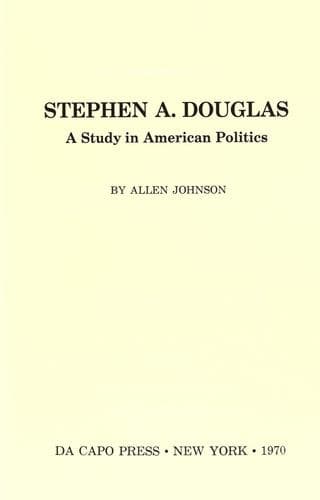
Stephen A. Douglas: A Study in American PoliticsJohnson, Allen
History
Stephen A. Douglas: A Study in American Politics
Johnson, Allen
Douglas, Stephen A. (Stephen Arnold), 1813-1861
Reluctant as Douglas must have been to accentuate the differences
between himself and the Southern Democrats, he could not remain
silent, for silence would be misconstrued. With all the tact which he
could muster out of a not too abundant store, he sought to conciliate,
without yielding his own opinions. It was a futile effort. At the very
outset he was forced to deny the right of slave property to other
protection than common property. Thence he passed with wider and wider
divergence from the Southern position over the familiar ground of
popular sovereignty. To the specific demands which Brown had voiced,
he replied that Congress had never passed an act creating a criminal
code for any organized Territory, nor any law protecting any species
of property. Congress had left these matters to the territorial
legislatures. Why, then, make an exception of slave property? The
Supreme Court had made no such distinction. "I know," said Douglas, in
a tone little calculated to soothe the feelings of his opponents, "I
know that some gentlemen do not like the doctrine of non-intervention
as well as they once did. It is now becoming fashionable to talk
sneeringly of 'your doctrine of non-intervention,' Sir, that doctrine
has been a fundamental article in the Democratic creed for years."
"If you repudiate the doctrine of non-intervention and form a slave
code by act of Congress, when the people of a Territory refuse it, you
must step off the Democratic platform.... I tell you, gentlemen of the
South, in all candor, I do not believe a Democratic candidate can ever
carry any one Democratic State of the North on the platform that it is
the duty of the Federal government to force the people of a Territory
to have slavery when they do not want it."[784]
What Brown had asserted with his wonted impulsiveness, was then
reaffirmed more soberly by his colleague, Jefferson Davis, upon whom
more than any other Southerner the mantle of Calhoun had fallen. State
sovereignty was also his major premise. The Constitution was a
compact. The Territories were common property of the States. The
territorial legislatures were mere instruments through which the
Congress of the United States "executed its trust in relation to the
Territories." If, as the Senator from Illinois insisted, Congress had
granted full power to the inhabitants of the Territories to legislate
on all subjects not inconsistent with the Constitution, then Congress
had exceeded its authority. Turning to Douglas, Davis said, "Now, the
senator asks, will you make a discrimination in the Territories? I
say, yes, I would discriminate in the Territories wherever it is
needful to assert the right of citizens.... I have heard many a
siren's song on this doctrine of non-intervention; a thing shadowy and
fleeting, changing its color as often as the chameleon."[785]
Public-domain text, read in full here on John Shaqi.
Reviews
Reviews
No reviews yet
Be the first to share your thoughts on this work.
Elsewhere in the archive
Join the Discussion
Join the discussion
Sign in to leave a comment or review.
Sign InorCreate an account