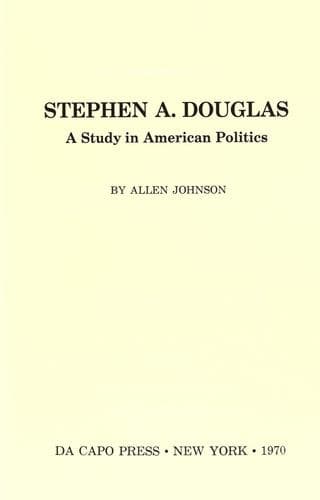
Stephen A. Douglas: A Study in American PoliticsJohnson, Allen
History
Stephen A. Douglas: A Study in American Politics
Johnson, Allen
Douglas, Stephen A. (Stephen Arnold), 1813-1861
Douglas took issue with the fundamental postulate of Lincoln's
syllogism--that a Territory is the mere creature of Congress and
cannot be clothed with powers not possessed by the creator. He denied
that such an inference could be drawn from that clause in the
Constitution which permits Congress to dispose of, and make all
needful rules for, the territory or other property belonging to the
United States. Names were deceptive. The word "territory" in this
connection was not used in a political, but in a geographical sense.
The power of Congress to organize governments for the Territories must
be inferred rather from the power to admit new States into the Union.
The Federal government possessed only expressly delegated powers; and
the absence of any explicit authority to interfere in local
territorial affairs must be held to inhibit any exercise of such
power. It was on these grounds that the Supreme Court had ruled that
Congress was not authorized by the Constitution to prohibit slavery in
the Territories.
It had been erroneously held by some, continued the essayist, that the
Court decided in the Dred Scott case that a territorial legislature
could not legislate in respect to slave property like other property.
He understood the Court to speak only of forbidden powers--powers
denied to Congress, to State legislatures and to territorial
legislatures alike. But if ever slavery should be decided to be one of
these forbidden subjects of legislation, then the conclusion would be
inevitable that the Constitution established slavery in the
Territories beyond the power of the people to control it by law, and
guaranteed to every citizen the right to go there and be protected in
the enjoyment of his slave property; then every member of Congress
would be in duty bound to supply adequate protection, if the rights of
property should be invaded. Not only so, but another conclusion would
follow,--if the Constitution should be held to establish slavery in
the Territories beyond the power of the people to control
it,--Congress would be bound to provide adequate protection for slave
property everywhere, _in the States_ as well as in the Territories.
Public-domain text, read in full here on John Shaqi.
Reviews
Reviews
No reviews yet
Be the first to share your thoughts on this work.
Elsewhere in the archive
Join the Discussion
Join the discussion
Sign in to leave a comment or review.
Sign InorCreate an account