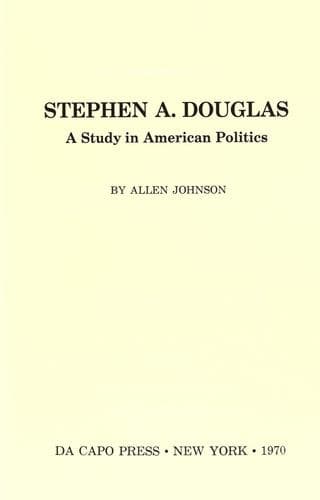
Stephen A. Douglas: A Study in American PoliticsJohnson, Allen
History
Stephen A. Douglas: A Study in American Politics
Johnson, Allen
Douglas, Stephen A. (Stephen Arnold), 1813-1861
Douglas immediately went on to show that such was not the decision of
the Court in the Dred Scott case. The Court had held that "the right
of property in slaves is distinctly and expressly affirmed in the
Constitution." Yes, but where? Why in that provision which speaks of
persons "held to service or labor in one State, under the laws
thereof"; not under the Constitution, not under the laws of Congress,
Douglas emphasized, but _under the laws of the particular State where
such service is due._ And so, when the Court declared that "the
government, in express terms, is pledged to protect it [slave
property] in all future time," it added "if the slave escapes from his
owner." "This is the only contingency," Douglas maintained, "in which
the Federal Government is authorized, required, or permitted to
interfere with slavery in the States or Territories; and in that case
only for the purpose of 'guarding and protecting the owner in his
rights' to reclaim his slave property." Slave-owners, therefore, who
moved with their property to a Territory, must hold it like all other
property, subject to local law, and look to local authorities for its
protection.
One other question remained: was the word "State," as used in the
clause just cited, intended to include Territories? Douglas so
contended. Otherwise, "the Territories must become a sanctuary for all
fugitives from service and justice." In numerous clauses in the
Constitution, the Territories were recognized as _States_.
Clever as this reasoning was, it clearly was not a fair exposition of
the opinion of the Court in the case of Dred Scott. If the Court did
not deny the right of a territorial legislature to interfere with
slave property, it certainly left that proposition open to fair
inference by the phrasing and emphasis of the critical passages. It
should be noted that Douglas, in quoting the decision, misplaced the
decisive clause so as to bring it in juxtaposition to the reference to
the fugitive slave clause of the Constitution, thus redistributing the
emphasis and confusing the real significance of the foregoing
paragraph.[798] Douglas stated subsequently that he did not believe
the decision of the Court reached the power of a territorial
legislature, because there was no territorial legislature in the
record nor any allusion to one; because there was no territorial
enactment before the Court; and because there was no fact in the case
alluding to or connected with territorial legislation.[799] All this
was perfectly true. The opinion of the Court was _obiter dicens_; but
the Court expressed its opinion nevertheless. As Lincoln said, men
knew what to expect of the Court when a territorial act prohibiting
slavery came before it. Yet this was what Douglas would not concede.
He would not admit the inference. Congress could confer powers upon a
territorial legislature which it could not itself exercise. The
dividing line between Federal and local authority was so drawn as to
Public-domain text, read in full here on John Shaqi.
Reviews
Reviews
No reviews yet
Be the first to share your thoughts on this work.
Elsewhere in the archive
Join the Discussion
Join the discussion
Sign in to leave a comment or review.
Sign InorCreate an account