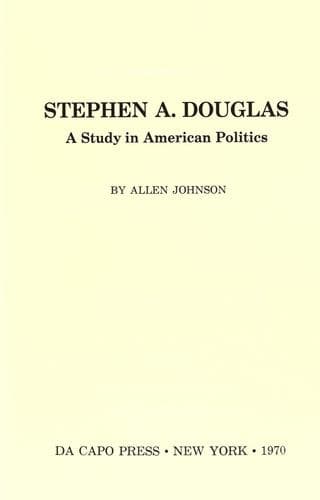
Stephen A. Douglas: A Study in American PoliticsJohnson, Allen
History
Stephen A. Douglas: A Study in American Politics
Johnson, Allen
Douglas, Stephen A. (Stephen Arnold), 1813-1861
Douglas was ready to acquit his colleagues in the Senate of a purpose
to dissolve the Union, but he did not hesitate to assert that such
principles as Yancey had advocated at Charleston would lead "directly
and inevitably" to a dissolution of the Union. Why was the South so
eager to repudiate the principle of non-intervention? By it they had
converted New Mexico into slave Territory; by it, in all probability,
they would extend slavery into the northern States of Mexico, when
that region should be acquired. "Why," he asked, "are you not
satisfied with these practical results? The only difference of opinion
is on the judicial question, about which we agreed to differ--which we
never did decide; because, under the Constitution, no tribunal on
earth but the Supreme Court could decide it." To commit the Democratic
party to intervention was to make the party sectional and to invite
never-ceasing conflict. "Intervention, North or South, means disunion;
non-intervention promises peace, fraternity, and perpetuity to the
Union, and to all our cherished institutions."[836]
The challenge contained in these words was not permitted to pass
unanswered. Davis replied with offensive references to the "swelling
manner" and "egregious vanity" of the Senator from Illinois. He
resented such dictation.[837] On the following day, May 17th, an
exciting passage-at-arms occurred between these representatives of
the Northwest and the Southwest. Douglas repeated his belief that
disunion was the prompting motive which broke up the Charleston
convention. Davis resented the insinuation, with fervent protestations
of affection for the Union of the States. It was the Senator from
Illinois, who, in his pursuit of power, had prevented unanimity, by
trying to plant his theory upon the party. The South would have no
more to do with the "rickety, double-construed platform" of 1856. "The
fact is," said Davis, "I have a declining respect for platforms. I
would sooner have an honest man on any sort of a rickety platform you
could construct, than to have a man I did not trust on the best
platform which could be made. A good platform and an honest man on it
is what we want."[838] Douglas reminded his opponent sharply that the
bolters at Charleston seceded, not on the candidate, but on the
platform. "If the platform is not a matter of much consequence, why
press that question to the disruption of the party? Why did you not
tell us in the beginning of this debate that the whole fight was
against the man, and not upon the platform?"[839]
Public-domain text, read in full here on John Shaqi.
Reviews
Reviews
No reviews yet
Be the first to share your thoughts on this work.
Elsewhere in the archive
Join the Discussion
Join the discussion
Sign in to leave a comment or review.
Sign InorCreate an account