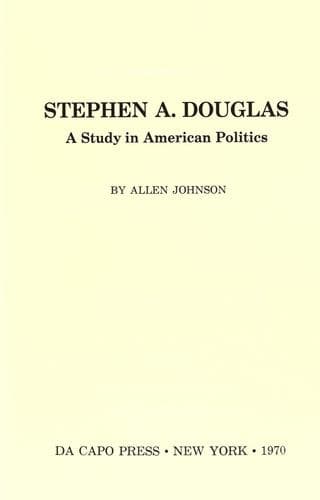
Stephen A. Douglas: A Study in American PoliticsJohnson, Allen
History
Stephen A. Douglas: A Study in American Politics
Johnson, Allen
Douglas, Stephen A. (Stephen Arnold), 1813-1861
In the interval between the Charleston and the Baltimore conventions,
the Davis resolutions were pressed to a vote in the Senate, with the
purpose of shaping party opinion. They passed by votes which gave a
deceptive appearance of Democratic unanimity. Only Senator Pugh parted
company with his Democratic colleagues on the crucial resolution; yet
he represented the popular opinion at the North.[840] The futility of
these resolutions, so far as practical results were concerned, was
demonstrated by the adoption of Clingman's resolution, that the
existing condition of the Territories did not require the intervention
of Congress for the protection of property in slaves.[841] In other
words, the South was insisting upon rights which were barren of
practical significance. Slave-holders were insisting upon the right to
carry their slaves where local conditions were unfavorable, and where
therefore they had no intention of going.[842]
The nomination of Lincoln rather than Seward, at the Republican
convention in Chicago, was a bitter disappointment to those who felt
that the latter was the real leader of the party of moral ideas, and
that the rail-splitter was simply an "available" candidate.[843] But
Douglas, with keener insight into the character of Lincoln, said to a
group of Republicans at the Capitol, "Gentlemen, you have nominated a
very able and a very honest man."[844] For the candidate of the new
Constitutional Union party, which had rallied the politically
unattached of various opinions in a convention at Baltimore, Douglas
had no such words of praise, though he recognized John Bell as a
Unionist above suspicion and as an estimable gentleman.
These nominations rendered it still less prudent for Northern
Democrats to accept a candidate with stronger Southern leanings than
Douglas. No Northern Democrat could carry the Northern States on a
Southern platform; and no Southern Democrat would accept a nomination
on the Douglas platform. Unless some middle ground could be
found,--and the debates in the Senate had disclosed none,--the
Democrats of the North were bound to adhere to Douglas as their first
and only choice in the Baltimore convention.
Public-domain text, read in full here on John Shaqi.
Reviews
Reviews
No reviews yet
Be the first to share your thoughts on this work.
Elsewhere in the archive
Join the Discussion
Join the discussion
Sign in to leave a comment or review.
Sign InorCreate an account