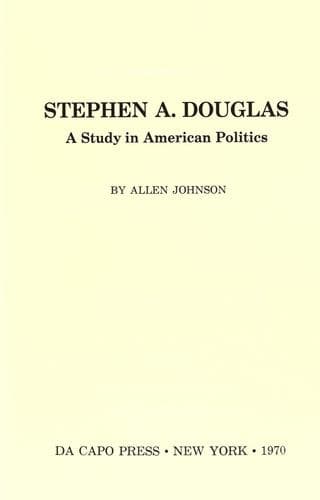
Stephen A. Douglas: A Study in American PoliticsJohnson, Allen
History
Stephen A. Douglas: A Study in American Politics
Johnson, Allen
Douglas, Stephen A. (Stephen Arnold), 1813-1861
The election in August was followed by weeks of suspense. Both parties
claimed the district vociferously. The official count finally gave the
election to Stuart by a majority of thirty-five, in a total vote of
over thirty-six thousand.[95] Possibly Douglas might have successfully
contested the election.[96] There were certain discrepancies in the
counting of the votes; but he declined to vex Congress with the
question, so he said, because similar cases were pending and he could
not hope to secure a decision before Congress adjourned. It is
doubtful whether this merciful consideration for Congress was
uppermost in his mind in the year 1838. The fact is, that Douglas
wrote to Senator Thomas H. Benton to ascertain the proper procedure in
such cases;[97] and abandoned the notion of carrying his case before
Congress, when he learned how costly such a contest would be.[98] He
had resigned his position as Register of the Land Office to enter the
campaign, and he had now no other resources than his profession.
It was comforting to the wounded pride of the young man to have the
plaudits of his own party, at least. He had made a gallant fight; and
when Democrats from all over the State met at a dinner in honor of
Governor-elect Carlin, at Quincy, they paid him this generous tribute:
"Although so far defeated in the election that the certificate will be
given to another, yet he has the proud gratification of knowing that
the people are with him. His untiring zeal, his firm integrity, and
high order of talents, have endeared him to the Democracy of the State
and they will remember him two years hence."[99] Meantime there was
nothing left for him to do but to solicit a law practice. He entered
into partnership with a Springfield attorney by the name of Urquhart.
By the following spring, Douglas was again dabbling in local politics,
and by late fall he was fully immersed in the deeper waters of
national politics. Preparations for the presidential campaign drew him
out of his law office,--where indeed there was nothing to detain
him,--and he was once again active in party conclaves. He presided
over a Democratic county convention, and lent a hand in the drafting
of a platform.[100] In November he was summoned to answer Cyrus
Walker, a Whig who was making havoc of the Democratic programme at a
mass-meeting in the Court House. In the absence of any reliable
records, nothing more can be said of Douglas's rejoinder than that it
moved the Whigs in turn to summon reinforcements, in the person of the
awkward but clever Lincoln. The debate was prolonged far into the
night; and on which side victory finally folded her wings, no man can
tell.[101] Douglas made the stronger impression, though Whigs
professed entire satisfaction with the performance of their
protagonist. There were some in the audience who took exception to
Lincoln's stale anecdotes, and who thought his manner clownish.[102]
Public-domain text, read in full here on John Shaqi.
Reviews
Reviews
No reviews yet
Be the first to share your thoughts on this work.
Join the Discussion
Join the discussion
Sign in to leave a comment or review.
Sign InorCreate an account