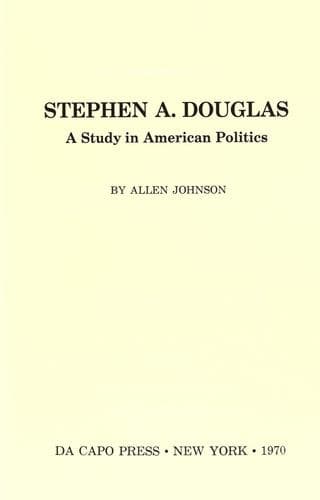
Stephen A. Douglas: A Study in American Politics — John Shaqi
Stephen A. Douglas: A Study in American PoliticsJohnson, Allen
History
Stephen A. Douglas: A Study in American Politics
Johnson, Allen
Douglas, Stephen A. (Stephen Arnold), 1813-1861
It has already been remarked that as judge, Douglas was potentially a
candidate for almost any public office. He still kept in touch with
Springfield politicians, planning with them the moves and
counter-moves on the checker-board of Illinois politics. There was
more than a grain of truth in the reiterated charges of the Whig
press, that the Democratic party was dominated by an arbitrary
clique.[146] It was a matter of common observation, that before
Democratic candidates put to sea in the troubled waters of State
politics, they took their dead-reckoning from the office of the _State
Register_. It was noised abroad in the late fall that Douglas would
not refuse a positive call from his party to enter national politics;
and before the year closed, his Springfield intimates were actively
promoting his candidacy for the United States Senate, to succeed
Senator Young. This was an audacious move, since even if Young were
passed over, there were older men far more justly entitled to
consideration. Nevertheless, Douglas secured in some way the support
of several delegations in the legislature, so that on the first ballot
in the Democratic caucus he stood second, receiving only nine votes
less than Young. A protracted contest followed. Nineteen ballots were
taken. Douglas's chief competitor proved to be, not Young, but Breese,
who finally secured the nomination of the caucus by a majority of five
votes.[147] The ambition of Judge Douglas had overshot the mark.
In view of the young man's absorbing interest in politics, his slender
legal equipment, and the circumstances under which he received his
appointment, one wonders whether the courts he held could have been
anything but travesties on justice. But the universal testimony of
those whose memories go back so far, is that justice was on the whole
faithfully administered.[148] The conditions of life in Illinois were
still comparatively simple. The suits instituted at law were not such
as to demand profound knowledge of jurisprudence. The wide-spread
financial distress which followed the crisis of 1837, gave rise to
many processes to collect debts and to set aside fraudulent
conveyances. "Actions of slander and trespass for assault and battery,
engendered by the state of feeling incident to pecuniary
embarrassment, were frequent."[149]
Public-domain text, read in full here on John Shaqi.
Reviews
Reviews
No reviews yet
Be the first to share your thoughts on this work.
Join the Discussion
Join the discussion
Sign in to leave a comment or review.
Sign InorCreate an account