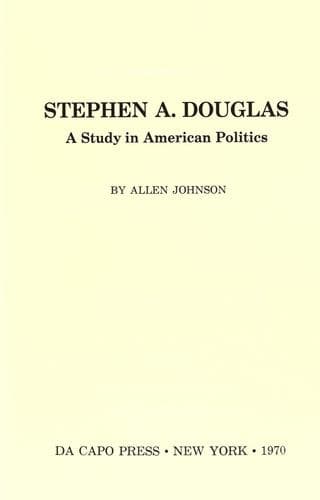
Stephen A. Douglas: A Study in American PoliticsJohnson, Allen
History
Stephen A. Douglas: A Study in American Politics
Johnson, Allen
Douglas, Stephen A. (Stephen Arnold), 1813-1861
The House was considering a bill to remit the fine imposed upon
General Andrew Jackson at New Orleans for contempt of court. It was a
hackneyed theme. No new, extenuating circumstances could be adduced to
clear the old warrior of high-handed conduct; but a presidential
election was approaching and there was political capital to be made by
defending "Old Hickory." From boyhood Douglas had idolized Andrew
Jackson. With much the same boyish indignation which led him to tear
down the coffin handbills in old Brandon, he now sprang to the defense
of his hero. The case had been well threshed already. Jackson had
been defended eloquently, and sometimes truthfully. A man of less
audacity would have hesitated to swell this tide of eloquence, and at
first, it seemed as though Douglas had little but vehemence to add to
the eulogies already pronounced. There was nothing novel in the
assertion that Jackson had neither violated the Constitution by
declaring martial law at New Orleans, nor assumed any authority which
was not "fully authorized and legalized by his position, his duty, and
the unavoidable necessity of the case." The House was used to these
dogmatic reiterations. But Douglas struck into untrodden ways when he
contended, that even if Jackson had violated the laws and the
Constitution, his condemnation for contempt of court was "unjust,
irregular and illegal." Every unlawful act is not necessarily a
contempt of court, he argued. "The doctrine of contempts only applies
to those acts which obstruct the proceedings of the court, and against
which the general laws of the land do not afford adequate
protection.... It is incumbent upon those who defend and applaud the
conduct of the judge to point out the specific act done by General
Jackson which constituted a contempt of court. The mere declaration of
martial law is not of that character.... It was a matter over which
the civil tribunals had no jurisdiction, and with which they had no
concern, unless some specific crime had been committed or injury done;
and not even then until it was brought before them according to the
forms of law."[166]
Public-domain text, read in full here on John Shaqi.
Reviews
Reviews
No reviews yet
Be the first to share your thoughts on this work.
Join the Discussion
Join the discussion
Sign in to leave a comment or review.
Sign InorCreate an account