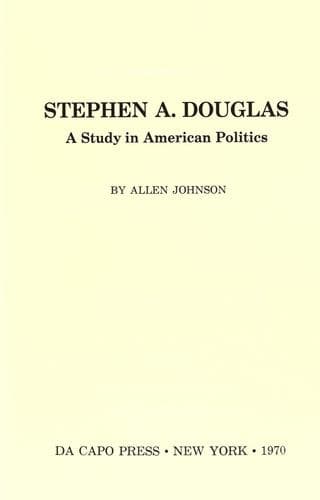
Stephen A. Douglas: A Study in American PoliticsJohnson, Allen
History
Stephen A. Douglas: A Study in American Politics
Johnson, Allen
Douglas, Stephen A. (Stephen Arnold), 1813-1861
A long and involved diplomatic history preceded President Polk's
simple announcement that "Mexico has passed the boundary of the United
States, has invaded our territory and shed American blood upon
American soil." Rightly to evaluate these words, the reader should
bear in mind that the mission of John Slidell to Mexico had failed;
that the hope of a peaceable adjustment of the Texas boundary and of
American claims against Mexico had vanished; and that General Taylor
had been ordered to the Rio Grande in disregard of Mexican claims to
that region. One should also know that, from the beginning of his
administration, Polk had hoped to secure from our bankrupt neighbor
the cession of California as an indemnity.[223] A motive for
forbearance in dealing with the distraught Mexican government was thus
wholly absent from the mind of President Polk.
Such of these facts as were known at the time, supplied the Whig
opposition in Congress with an abundance of ammunition against the
administration. Language was used which came dangerously near being
unparliamentary. So the President was willing to sacrifice Oregon to
prosecute this "illegal, unrighteous and damnable war" for Texas,
sneered Delano. "Where did the gentleman from Illinois stand now? Was
he still in favor of 61?" This sally brought Douglas to his feet and
elicited one of his cleverest extempore speeches. He believed that
such words as the gentleman had uttered could come only from one who
desired defeat for our arms. "All who, after war is declared, condemn
the justice of our cause, are traitors in their hearts. And would to
God that they would commit some overt act for which they could be
dealt with according to their deserts." Patriots might differ as to
the expediency of entering upon war; but duty and honor forbade
divided counsels after American blood had been shed on American soil.
Had he foreseen the extraordinary turn of the discussion, he assured
his auditors, he could have presented "a catalogue of aggressions and
insults; of outrages on our national flag--on persons and property of
our citizens; of the violation of treaty stipulations, and the murder,
robbery, and imprisonment of our countrymen." These were all anterior
to the annexation of Texas, and perhaps alone would have justified a
declaration of war; but "magnanimity and forbearance toward a weak and
imbecile neighbor" prevented hostilities. The recent outrages left the
country no choice but war. The invasion of the country was the last of
the cumulative causes for war.
Public-domain text, read in full here on John Shaqi.
Reviews
Reviews
No reviews yet
Be the first to share your thoughts on this work.
Elsewhere in the archive
Join the Discussion
Join the discussion
Sign in to leave a comment or review.
Sign InorCreate an account