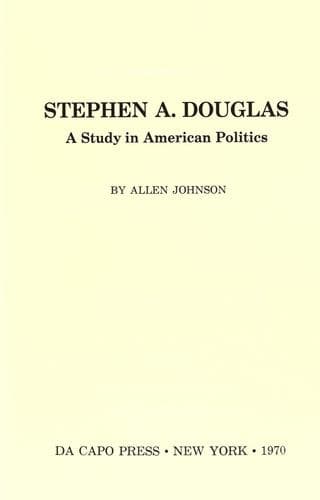
Stephen A. Douglas: A Study in American PoliticsJohnson, Allen
History
Stephen A. Douglas: A Study in American Politics
Johnson, Allen
Douglas, Stephen A. (Stephen Arnold), 1813-1861
But was the invaded territory properly "our country"? This was the
_crux_ of the whole matter. On this point Douglas was equally
confident and explicit. Waiving the claims which the treaty of San
Ildefonso may have given to the boundary of the Rio Grande, he rested
the whole case upon "an immutable principle"--the Republic of Texas
held the country on the left bank of that river by virtue of a
successful revolution. The United States had received Texas as a State
with all her territory, and had no right to surrender any portion of
it.[224]
The evidence which Douglas presented to confirm these claims is highly
interesting. The right of Texas to have and to hold the territory from
the Nueces to the Rio Grande was, in his opinion, based
incontrovertibly on the treaty made by Santa Anna after the battle of
San Jacinto, which acknowledged the independence of Texas and
recognized the Rio Grande as its boundary. To an inquiry whether the
treaty was ever ratified by the government of Mexico, Douglas replied
that he was not aware that it had been ratified by anyone except Santa
Anna, for the very good reason that he was the government at the time.
"Has not that treaty with Santa Anna been since discarded by the
Mexican government?" asked the venerable J.Q. Adams. "I presume it
has," replied Douglas, "for I am not aware of any treaty or compact
which that government ever entered into that has not either been
violated or repudiated by them afterwards." But Santa Anna, as
recognized dictator, was the _de facto_ government, and the acts of a
_de facto_ government were binding on the nation as against foreign
nations. "It is immaterial, therefore, whether Mexico has or has not
since repudiated Santa Anna's treaty with Texas. It was executed at
the time by competent authority. She availed herself of all its
benefits." Forthwith Texas established counties beyond the Nueces,
even to the Rio Grande, and extended her jurisdiction over that
region, while in a later armistice Mexico recognized the Rio Grande as
the boundary. It was in the clear light of these facts that Congress
had passed an act extending the revenue laws of the United States
over the country between the Rio Grande and the Nueces--the very
country in which American soldiers had been slain by an invading
force.
Public-domain text, read in full here on John Shaqi.
Reviews
Reviews
No reviews yet
Be the first to share your thoughts on this work.
Elsewhere in the archive
Join the Discussion
Join the discussion
Sign in to leave a comment or review.
Sign InorCreate an account