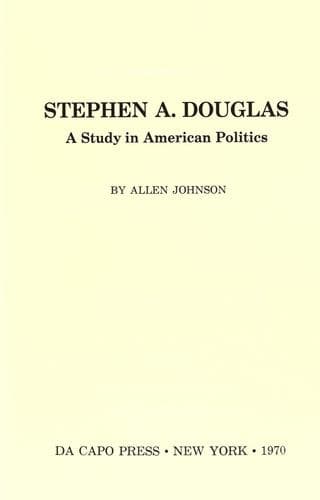
Stephen A. Douglas: A Study in American PoliticsJohnson, Allen
History
Stephen A. Douglas: A Study in American Politics
Johnson, Allen
Douglas, Stephen A. (Stephen Arnold), 1813-1861
Hardly had the war begun when there was a wild scramble among
Democrats for military office. It seemed to the distressed President
as though every Democratic civilian became an applicant for some
commission. Particularly embarrassing was the passion for office that
seized upon members of Congress. Even Douglas felt the spark of
military genius kindling within him. His friends, too, were convinced
that he possessed qualities which would make him an intrepid leader
and a tactician of no mean order. The entire Illinois delegation
united to urge his appointment as Brigadier Major of the Illinois
volunteers. Happily for the President, his course in this instance was
clearly marked out by a law, which required him to select only
officers already in command of State militia.[230] Douglas was keenly
disappointed. He even presented himself in person to overrule the
President's objection. The President was kind, but firm. He advised
Douglas to withdraw his application. In his judgment, Mr. Douglas
could best serve his country in Congress. Shortly afterward Douglas
sent a letter to the President, withdrawing his application--"like a
sensible man," commented the relieved Executive.[231] It is not likely
that the army lost a great commander by this decision.
In a State like Illinois, which had been staunchly Democratic for many
years, elections during a war waged by a Democratic administration
were not likely to yield any surprises. There was perhaps even less
doubt of the result of the election in the Fifth Congressional
District. By the admission of his opponents Douglas was stronger than
he had been before.[232] Moreover, the war was popular in the counties
upon whose support he had counted in other years. He had committed no
act for which he desired general oblivion; his warlike utterances on
Oregon, which had cost him some humiliation at Washington, so far from
forfeiting the confidence of his followers, seem rather to have
enhanced his popularity. Douglas carried every county in his district
but one, and nearly all by handsome majorities. He had been first sent
to Congress by a majority over Browning of less than five hundred
votes; in the following canvass he had tripled his majority; and now
he was returned to Congress by a majority of over twenty-seven hundred
votes.[233] He had every reason to feel gratified with this showing,
even though some of his friends were winning military glory on Mexican
battlefields. So long as he remained content with his seat in the
House, there were no clouds in his political firmament. Not even the
agitation of Abolitionists and Native Americans need cause him any
anxiety, for the latter were wholly a negligible political quantity
and the former practically so.[234] Everywhere but in the Seventh
District, from which Lincoln was returned, Democratic Congressmen were
chosen; and to make the triumph complete, a Democratic State ticket
was elected and a Democratic General Assembly again assured.
Public-domain text, read in full here on John Shaqi.
Reviews
Reviews
No reviews yet
Be the first to share your thoughts on this work.
Elsewhere in the archive
Join the Discussion
Join the discussion
Sign in to leave a comment or review.
Sign InorCreate an account